Welcome to Leader Aluminum
How to Calculate Aluminum Profile Theoretical Weight
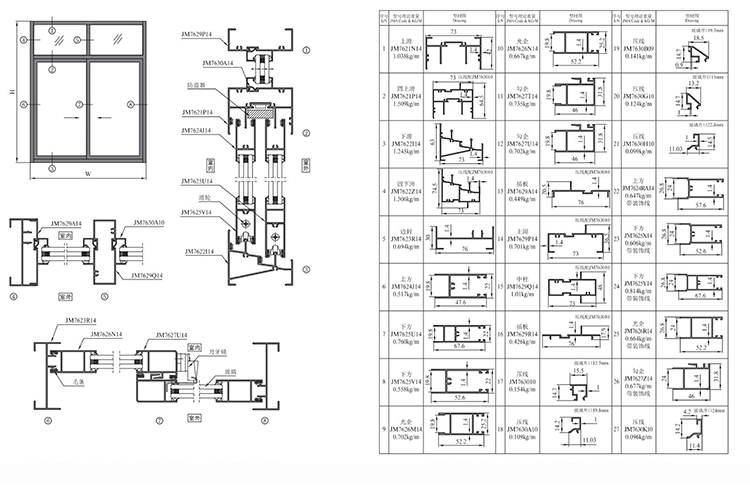
In international B2B aluminum procurement, accuracy is money. When ordering custom extrusions, knowing how to accurately calculate the theoretical weight of your profiles is a vital skill. It allows your logistics team to forecast ocean freight costs, helps engineers verify structural load-bearing tolerances, and ensures you are paying a fair price based on raw material volume.
At Aluleader, transparency is our core policy. To help our global sourcing partners eliminate guesswork, our engineering team has put together this definitive guide to calculating aluminum extrusion weight using standard industrial formulas.
1. The Core Scientific Formula
The weight of any aluminum profile is determined by its physical volume and the specific density of the aluminum alloy grade. The basic engineering equation is:
Weight (kg) = Volume(m^3) x Density(kg/m^3)
Since calculating volume in cubic meters on a factory floor is impractical, the industry standard formula simplifies this down to the profile’s cross-sectional area and total length:
Weight per Meter (kg/m)= Cross-Sectional Area (mm^2) x Density (g/cm^3) /1000
2. Factoring in Alloy Density Values
A common mistake made by junior procurement officers is using a single blanket density value for all metals. Different aluminum alloys contain varying amounts of elements like Magnesium, Silicon, Copper, or Zinc, which slightly alters their weight.
6063 Alloy Density: The global benchmark for architectural profiles is 2.69 g/cm^3) (or 2690 kg/m^3)
6061 Alloy Density: The slightly heavier structural alloy sits at 2.70 g/cm^3 (or 2700 kg/m^3).
Practical Example: If your custom
450 x 2.69 / 1000 = 1.2105 kg/m
If your total order requires 1,000 bars, and each bar is exactly 6 meters long, your total theoretical order weight is:
1.2105 kg/m x 6 m x 1000 = 7,263 kg
3. Account for Fabrication Variations and Finishes
While theoretical weight is perfect for initial shipping quotes, your final bill of lading will experience minor shifts during secondary manufacturing processes:
CNC Machining Losses: Milling slots, punching holes, and tapping threads remove metal mass. If your industrial framing requires heavy precision milling, the actual weight will be lower than the theoretical CAD profile weight. (Explore our drilling and milling capabilities on our
Aluminum Fabrication Services Anodizing vs. Powder Coating: Anodizing etches microscopic amounts of aluminum away before sealing, resulting in virtually zero weight change. However, an 80-micron architectural powder coating layer wraps around the entire perimeter of the profile, adding roughly 3% to 5% to the final physical scale weight of thin-walled profiles.
Miscalculations on aluminum weight can lead to unexpected container overloads and thousands of dollars in port penalties. Relying on a supplier who provides vague weight estimates often means you are either overpaying for ghost metal or getting thin-walled, compromised profiles that fail inspection.
At Aluleader, our automated CAD software syncs with our digital extrusion line scales, ensuring that your theoretical project weights align perfectly with real-world material density. We give you full transparency down to the exact kilogram.
Do you have a complex custom profile design and need an exact weight and cost analysis?
GuangDong Leader Aluminium Profiles Co.,Ltd (OEM&ODM)
is a comprehensive enterprise with over 10 years experence,engaging in the design, production and sales of aluminum profiles.Learn more...
If you have any question, feel free to contact us, Thank You !
Whatsapp: +8619867251009 Email: [email protected]