Welcome to Aluleader Metal
Aluminum Extrusion Tubes for AI Data Center Liquid Cooling | Aluleader
The rapid expansion of artificial intelligence and high-performance computing is fundamentally reshaping data center infrastructure. Training large language models requires thousands of GPUs operating continuously for months, generating unprecedented levels of heat. Traditional air-cooling systems are approaching their physical limits as server racks now operate in the 50kW to 250kW range, with next-generation deployments expected to approach the megawatt scale.
In this context, liquid cooling has emerged as the only scalable solution capable of supporting next-generation AI infrastructure. At the heart of these advanced thermal management systems lies a critical component: precision aluminum extrusion tubes.
This guide explores how high-tolerance aluminum tubing enables efficient liquid cooling for AI data centers, examining the technology, alloys, and design considerations that make it essential for modern thermal management.

The AI Cooling Challenge
Why Air Cooling Is No Longer Sufficient
AI workloads present unique thermal challenges. GPUs designed for AI training and inference can consume more than ten times the power of conventional processors, dramatically increasing rack-level power density and associated thermal load.
As rack power densities exceed the 40kW to 50kW threshold, maintaining uniform airflow distribution becomes increasingly difficult. This leads to recirculation, thermal stratification, and localized hotspots that can compromise system reliability and increase the risk of hardware failure.
Liquids are superior heat conductors to air. Liquid cooling systems operate with greater efficiency, reducing cooling energy consumption, lowering operating costs, and improving thermal performance. Most new AI-focused data centers will require liquid cooling by design, while many legacy facilities may need retrofitting as workload demands evolve.
Precision Aluminum Extrusion Tubes: The Critical Component
What Defines High-Tolerance Aluminum Tubing?
In traditional aluminum extrusion, emphasis is placed on shape accuracy and mass production speed. For AI liquid cooling applications, a variation of 0.1mm does not cut it. High-tolerance aluminum tubing is defined by:
Ultra-tight wall thickness control (±0.02mm or better)
High concentricity and straightness
Uniform surface roughness
Consistent mechanical properties along the tube length
Achieving this requires more than improved dies. Modern precision extrusion integrates optimized alloy flow simulation, real-time dimensional monitoring, controlled cooling, and post-extrusion stretching. The result is aluminum tubing that behaves as a functional engineering component, not a commodity material.
Multi-Port Extrusion (MPE) Technology
One of the newest developments in precision extrusion is multi-port extrusion (MPE). MPE ensures that aluminum tubes have multiple interior micro-channels that significantly enhance the heat transfer area without necessarily increasing bulk or weight.
In advanced thermal systems, wall thicknesses can be reduced to 0.2–0.3mm, enabling rapid thermal response. However, not all aluminum alloys are suitable for such structures. Alloy fluidity, grain refinement, and extrusion stability determine whether micro-channel designs are achievable at scale.
Flat Tube Liquid Cold Plates
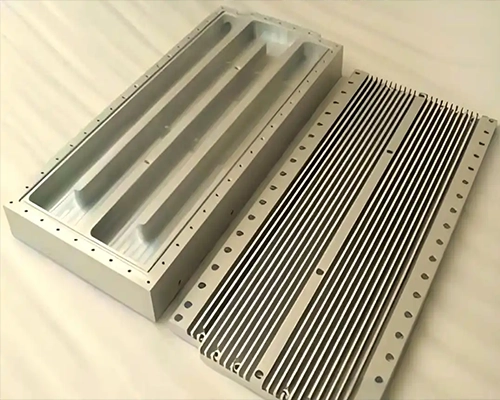
Aluminum multi-port extrusion tubing is used in compact thermal management solutions that offer extremely low thermal resistance. These extrusions utilize thin external walls to minimize thermal resistance between the cold plate and heat source mounting surface. The MPE tubes contain internal fins that provide additional surface area, increasing thermal performance and offering excellent thermal uniformity as coolant flows below the entire surface.
The large internal surface area combined with low pressure drop makes these cold plates ideal for use with viscous and poor heat transfer fluids such as ethylene glycol-water mixtures, oils, and specialty coolants.
Alloy Selection: Balancing Thermal Performance and Structural Integrity
6063 Aluminum: The Thermal Conductivity Leader
6000-series alloys (Al-Mg-Si) offer thermal conductivity of 200–218 W/m·K, making them excellent choices for applications where heat dissipation is the primary concern. 6063 is widely used for heat sinks and cooling applications due to its good extrudability and thermal performance.
For standard liquid cooling plates where thermal efficiency is paramount, 6063 remains a preferred choice. At Aluleader, our architectural profiles and industrial profiles frequently utilize 6063 alloy for thermal management applications.
7003 Aluminum: The Structural Alternative
7003 aluminum alloy (Al-Zn-Mg-Zr family) offers significantly higher yield and tensile strength than 6000-series alloys, with improved fatigue resistance and better structural performance under dynamic loads.
In terms of thermal conductivity, 6063 aluminum (T6) provides 200–218 W/m·K, while 7003 aluminum (T5/T6) offers 130–150 W/m·K. For yield strength, 6063 delivers 170–214 MPa compared to 7003's 300–360 MPa. Tensile strength for 6063 ranges from 185–240 MPa, while 7003 achieves 350–400 MPa.
7003 aluminum tubes are commonly supplied in T5 or T6 temper. T5 offers higher extrusion efficiency with good strength at lower cost, while T6 provides maximum mechanical strength after solution treatment and aging.
For liquid cooling plates that must also serve structural functions—such as battery trays or server rack supports—7003 offers an attractive balance of strength and thermal management capability.
Liquid Cooling Plate Manufacturing Technologies
Extruded Channel Design
Flow channels in liquid cooling plates can be formed using internal cavities of aluminum extrusion profiles. While channel layouts are more regular than machined alternatives, key parameters such as plate thickness, channel width, and the number of parallel channels can be optimized through numerical simulation.
Extruded liquid cooling plates offer several advantages: short and efficient production processes, high structural strength, lower manufacturing costs, and excellent suitability for mass production. Because of these benefits, extrusion-based aluminum liquid cooling plate solutions are widely used in practical applications.
Friction Stir Welding (FSW) Assembly
To further enhance performance and reliability, multiple extruded aluminum sections can be joined using friction stir welding (FSW). This results in a FSW liquid cold plate with a simple structure, strong sealing performance, and high mechanical strength.
A typical unit liquid cold plate consists of one main aluminum plate, two end caps, and two inlet/outlet connectors. All components are made of aluminum alloy and assembled through machining, FSW, and arc welding. The end caps are joined to the main plate using FSW, ensuring excellent sealing and minimizing leakage risk.
Thick Rib Structure Advantages
Compared with thin-wall designs, a thick rib structure provides easier channel sealing, improved mechanical strength, better compatibility with mounting points, and reduced leakage risk. In this design, coolant flows through internal cavities while reinforced rib sections remain solid, preventing leakage even when mounting structures penetrate the plate.
Serpentine Flow Channel Optimization
The internal channel of the unit liquid cooling plate typically adopts a single-inlet, single-outlet serpentine design. This structure is simple and effective for heat transfer. However, increasing the number of channel loops also increases flow resistance. Excessive pressure drop can reduce coolant flow efficiency, increase energy consumption, and cause cavitation risks.
Based on simulation and experimental data, a four-loop serpentine channel design provides a good balance between cooling performance and pressure drop. In most systems, the pressure drop is typically controlled within 20–30 kPa.
Direct-to-Chip Cooling: The AI Application
Direct-to-chip cooling (D2C) has emerged as a high-efficiency thermal management strategy to address the increasing power densities of modern CPUs and GPUs deployed in hyperscale and AI-oriented data centers.
Unlike conventional air-cooling systems, D2C technology circulates a dielectric or water-based coolant directly through cold plates mounted on high-heat-flux components, allowing localized heat extraction at the source. This strategy markedly increases heat transfer coefficients, reduces thermal resistance, and allows for higher rack power densities while maintaining stable junction temperatures.
Experimental and simulation studies have reported considerable increases in energy efficiency, including lower Power Usage Effectiveness (PUE) values and reduced fan energy consumption. Furthermore, D2C enables heat reuse strategies through elevated coolant outlet temperatures, aiding sustainable data center design.
Design Considerations for AI Liquid Cooling
Thermal Simulation and Optimization
In AI data center applications, thermal performance cannot rely on standard design solutions. Cooling solutions must be developed based on actual operating environments to ensure performance and reliability even under harsh conditions.
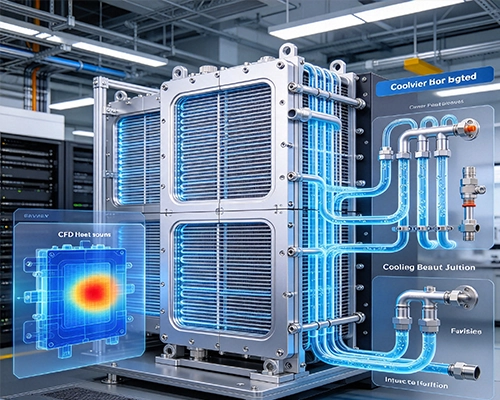
Advanced computational fluid dynamics (CFD) simulation tools analyze heat distribution, airflow patterns, and fluid dynamics. This enables prediction of temperature variations before production and identification of potential hotspots early in the design phase.
For high-power AI systems, internal channels must be designed to ensure even coolant distribution, reduce pressure loss, and maximize heat exchange efficiency—all critical for maintaining stable GPU and CPU performance.
Modular Assembly and Scalability
For large cooling requirements, multiple unit liquid cooling plates are joined together using FSW to form larger assemblies. This modular design offers flexible scalability, high structural integrity, the ability to serve as both cooling and load-bearing structures, and simplified installation.
In practical applications, multiple liquid cooling plates are often connected in parallel to form a complete cooling system. Compared with series connections, parallel systems offer lower overall flow resistance, better temperature uniformity, and improved cooling efficiency.
Cooling System Layout
The cooling system typically includes inlet and outlet pipelines, flexible hoses, connectors, and sealing components. Flexible hoses are preferred due to their corrosion resistance and ease of installation. Flow distribution is controlled through pipeline layout.
Simulation studies using a 50/50 ethylene glycol-water mixture at 15 L/min show that simple layouts have lower pressure drop but poor flow uniformity, while multi-stage inlet designs improve flow consistency. A three-stage inlet configuration provides the best balance between pressure drop and flow uniformity.
Frequently Asked Questions (FAQ)
Q: Why is liquid cooling necessary for AI data centers?
A: AI workloads require thousands of GPUs operating continuously, generating unprecedented heat. Traditional air cooling cannot support the thermal demands of AI and HPC environments as rack power densities exceed 40-50kW. Liquid cooling is the only scalable solution for next-generation AI infrastructure.
Q: What is multi-port extrusion (MPE) and why is it important?
A: MPE creates aluminum tubes with multiple interior micro-channels that significantly enhance heat transfer area without increasing bulk or weight. This technology enables compact, high-performance liquid cooling plates with internal fins that maximize thermal performance.
Q: Which aluminum alloy is best for liquid cooling applications?
A: 6063 aluminum offers excellent thermal conductivity (200–218 W/m·K) and is ideal for heat dissipation-focused applications. 7003 aluminum provides higher strength (300–360 MPa yield strength) for applications where the cooling plate also serves structural functions. The choice depends on whether thermal performance or structural integrity is the primary concern.
Q: What is direct-to-chip cooling?
A: Direct-to-chip cooling circulates coolant through cold plates mounted directly on high-heat-flux components like GPUs and CPUs. This allows localized heat extraction at the source, markedly increasing heat transfer coefficients and enabling higher rack power densities while maintaining stable junction temperatures.
Q: How are extruded aluminum liquid cooling plates manufactured?
A: Extruded cooling plates use aluminum extrusion profiles with internal cavities that form flow channels. Multiple sections can be joined using friction stir welding (FSW) to create larger assemblies with strong sealing performance and high mechanical strength.
Q: What is the typical pressure drop in serpentine cooling channels?
A: Based on simulation and experimental data, a four-loop serpentine channel design provides a good balance between cooling performance and pressure drop. In most systems, the pressure drop is typically controlled within 20–30 kPa.
Related Posts
Corrosion Protection for Aluminum Extrusions — Learn about surface treatments that protect cooling components in demanding environments.
Aluminum Enclosure IP Rating Guide — Understand enclosure protection standards for data center equipment.
Extruded Aluminum vs Die Cast: Comparison Guide — Compare manufacturing processes for cooling component production.
Applications of Aluminum Extrusion in Different Industries — Explore how extrusion serves electronics, automotive, construction, and more.
Aluminum Extrusion Process: 11 Key Steps Explained — Understand the manufacturing process behind precision tubing.
About Aluleader
With over 15 years of experience in the aluminum extrusion industry, Aluleader provides high-quality architectural profiles, industrial profiles, and furniture/decorative profiles. Our integrated capabilities—from die design and extrusion to CNC machining, surface finishing, and fabrication—ensure consistent quality across every project.
For customers in the electronics and data center industries, we offer custom-extruded aluminum components with precise tolerances, including micro-channel tubing and cooling plate profiles. Our engineering team collaborates with clients to optimize designs for thermal performance and manufacturability.
For project-specific questions or detailed inquiries about our extrusion capabilities for cooling applications, our experts are available to provide technical guidance.