Welcome to Aluleader Metal
T5 vs T6 Aluminum Temper: Hardness, Strength & Application Comparison | Aluleader Metal
T5 vs T6 Aluminum Temper: Hardness, Strength & Complete Comparison
When engineers and project managers source aluminum extrusions, one question comes up more than any other: aluminum temper T5 vs T6 — which one should I use? The difference isn't just a number. It changes everything from hardness and strength to cost, bendability, and even surface finish after anodizing.
At Aluleader Metal, we extrude thousands of tons of T5 and T6 profiles every year for window factories, solar mounting systems, automation equipment, and curtain wall projects. In this guide, we break down exactly how T5 and T6 tempers work, where each performs best, and how to pick the right one for your next project — without overpaying for performance you don't need.
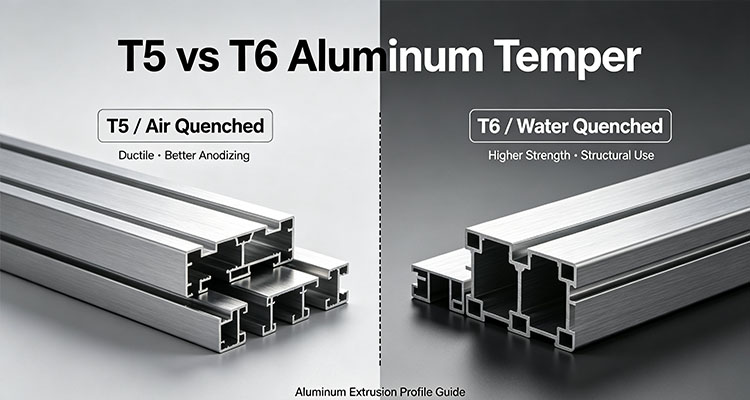
What Is T5 & T6 Temper for Aluminum Extrusion?
Before comparing specs, let's clarify what "temper" actually means. Aluminum temper describes the heat treatment process applied to an extrusion after it leaves the die. The process controls how the alloy's internal crystal structure forms, which directly determines hardness, strength, and ductility.
T5 Aluminum Temper: Air Quenched & Artificially Aged
T5 is the most common temper for architectural and decorative aluminum profiles. Here's how it works:
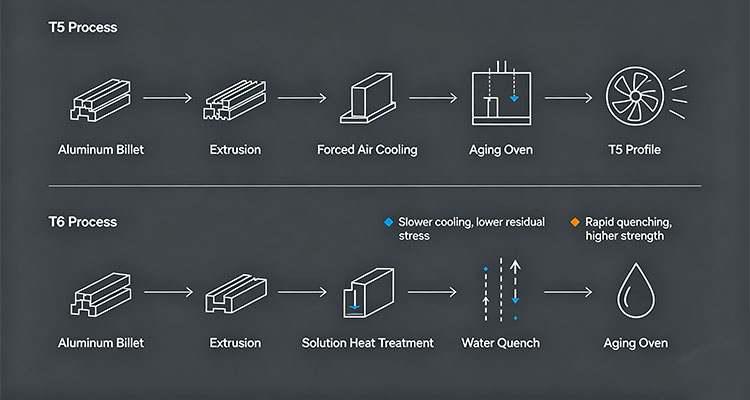
First, a hot aluminum billet is pushed through the extrusion die at around 480–520°C. The profile exits the die and is cooled rapidly with forced air — that's air quenching — while still on the runout table. After cooling, the profile goes into an aging oven at roughly 175°C for several hours to artificially age and reach its final hardness.
The key characteristic of T5 is that cooling happens in air, not water. This means the profile cools more slowly and more evenly, resulting in lower residual stress and better dimensional stability.
T6 Aluminum Temper: Solution Heat Treated & Artificially Aged
T6 is the high-strength temper used for structural and load-bearing applications. The process is more involved than T5.
After extrusion, the profile undergoes solution heat treatment — it's heated to a precise temperature, around 530–560°C, and held there to dissolve alloying elements uniformly throughout the material. The profile is then rapidly quenched in water or mist to "freeze" the dissolved elements in place, creating a supersaturated solid solution. Finally, artificial aging in an oven precipitates the alloying elements in a fine, uniform distribution, maximizing strength and hardness.
The key characteristic of T6 is that the water quench is much faster and more aggressive than air cooling. This locks in the supersaturated structure that, after aging, delivers significantly higher strength and hardness than T5.
Quick takeaway: T5 = air cooled + aging. T6 = solution heat treated + water quenched + aging. T6 is stronger, but T5 is more stable and easier to fabricate.Core Differences: T5 vs T6 Aluminum
Let's get into the details. Below is a side-by-side breakdown of the most important properties, based on standard 6063 and 6061 aluminum alloys.
Cooling Method
The cooling method is the root cause of most differences between T5 and T6 tempers.-T5 uses forced air quenching right after extrusion. The slower, more uniform cooling creates low residual stress in the finished profile, which means minimal distortion after cutting or machining. This makes T5 excellent for long profiles that need straightness, like 6-meter window extrusions.-T6 uses water or mist quenching after a separate solution heat treatment step. The extremely rapid cooling creates thermal gradients that lock higher residual stress into the material. T6 profiles may distort or bow if not properly stretched and straightened after quenching, and heavy machining on one side can release stress and cause unexpected warping.
Hardness
Hardness is the property most people ask about first, and it's where the difference between T5 and T6 is most obvious.-T5 hardness — specifically 6063-T5 — typically measures 8 to 12 on the Webster hardness scale. This is the standard for window frames, door profiles, curtain walls, and decorative trim. It's hard enough to resist everyday dents and scratches but still easy to cut, drill, and assemble on-site.-T6 hardness — specifically 6061-T6 — measures 12 to 16+ Webster hardness. That's roughly 30 to 50 percent harder than T5. This makes T6 suitable for load-bearing frames, solar panel mounting rails, machine guards, and structural components where deflection under load is a concern.⚠️ Important: Hardness numbers vary by alloy. 6063-T5 and 6061-T6 are the most common pair, but they're different alloys entirely. When comparing tempers, always compare the same alloy in different tempers — not different alloys.
Tensile & Yield Strength
The yield strength gap is where T6 really earns its place. Yield strength is the point at which the material permanently deforms — the number engineers actually design around.-6063-T5 has a yield strength of roughly 110 to 145 MPa, with tensile strength around 150 to 180 MPa. This is more than enough for windows, doors, and frames that mainly hold glass or serve as enclosure.-6061-T6 has a yield strength of roughly 240 to 275 MPa, with tensile strength around 260 to 310 MPa. That's strong enough for solar mounting systems that must withstand wind and snow loads, industrial machine frames, conveyor systems, and structural supports.For context: A 6061-T6 profile can carry roughly twice the load of a 6063-T5 profile of the same cross-section before yielding. That's why structural engineers almost always specify T6 for anything load-bearing.
Ductility & Elongation
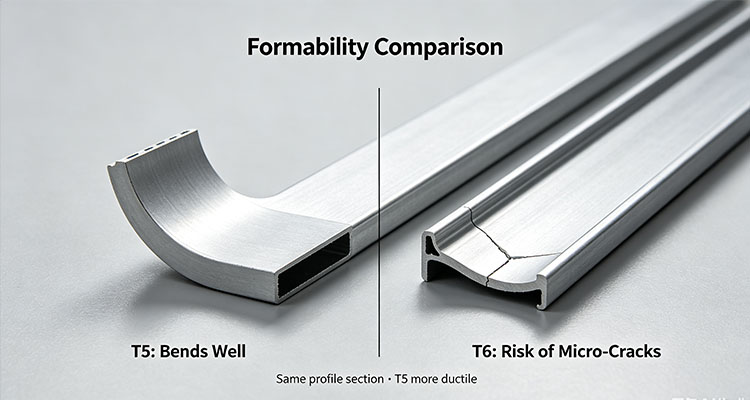
Ductility determines how much a material can bend or stretch before breaking — and this is where T5 has a clear advantage.-T5 profiles have higher elongation, typically 8 to 12 percent. The higher ductility means T5 extrusions can bend to tighter radii without the outer surface cracking. This is why all aluminum window and curtain wall profiles are T5 temper — they get bent into frames, notched, and assembled on-site.-T6 profiles are more brittle, with elongation of only 5 to 8 percent. Bending T6 aluminum, especially to a tight radius, frequently causes micro-cracks or visible fissures on the outer bend surface. In structural applications, these cracks can propagate under load and compromise safety.🔧 Practical tip:If you need a bent profile with decent strength, ask your supplier about T4 temper — solution heat treated but not aged. T4 bends well and then naturally ages to near-T6 strength over time at room temperature. It's a common trick for bent structural parts.
Formability & Bendability
If your project involves bending, roll forming, or post-extrusion fabrication, this is the most critical difference between T5 and T6.-T5 profiles bend beautifully. The higher ductility means you can bend T5 extrusions to tight radii without the outer surface cracking. This is why all aluminum window and curtain wall profiles are T5 temper — they get bent into frames, notched, and assembled on-site.-T6 profiles are much more brittle. Bending T6 aluminum, especially to a tight radius, frequently causes micro-cracks or visible fissures on the outer bend surface. In structural applications, these cracks can propagate under load and compromise safety. For gentle curves with very large radii, T6 can work, but tight bends should be avoided.
Surface Finish & Anodizing Performance
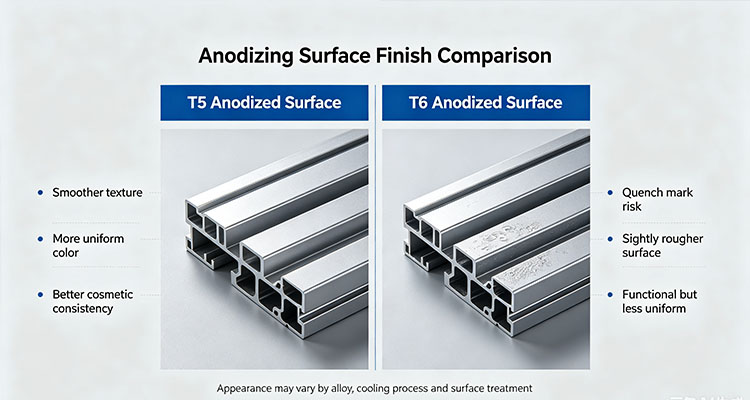
Here's a detail many people miss: temper affects how the profile looks after surface treatment.-T5 produces a smoother base surface from slower air cooling, which results in a more uniform and consistent anodic oxide layer. The color consistency across batches is better, making T5 ideal for decorative and architectural applications where appearance matters.-T6 can have a slightly rougher surface texture after water quenching. The oxide layer may be slightly less uniform, and T6 profiles are more prone to "water stain" or quenching marks if not properly handled. T6 is still perfectly functional for anodizing, but cosmetic consistency is harder to guarantee.For projects where the aluminum is visible — storefronts, office partitions, furniture — T5 almost always gives a better cosmetic result. For hidden structural parts, it doesn't matter.
Dimensional Stability
Dimensional stability matters for precision parts and long profiles that need to stay straight.-T5 has excellent dimensional stability. The slower air cooling creates low residual stress, so profiles stay straight and true after cutting, drilling, or machining. This is why long architectural profiles — up to 6 meters or more — are almost always T5.-T6 has moderate dimensional stability. The aggressive water quench creates higher residual stress in the material. If you machine heavily on one side of a T6 profile, the released stress can cause the part to bow or warp. For precision-machined parts, many engineers specify T651 temper — T6 plus stress relieving by stretching — instead of standard T6.
Typical Alloys
Different tempers pair with different alloys, depending on the application.-T5 is most commonly paired with 6063 and 6060 alloys. These alloys extrude very well, can hold fine surface details, and take anodizing beautifully. They're the standard for architectural and decorative profiles.-T6 is most commonly paired with 6061, 6082, and 6005A alloys. These alloys have higher strength when fully heat treated, making them the go-to choice for structural and industrial applications. 6061-T6 is the strongest common 6xxx T6 alloy; 6082-T6 is popular in Europe; 6005A-T6 is widely used for solar mounting rails.
Production Cost & Lead Time
T6 costs more and takes longer to produce, and there are good reasons for both.-T5 has lower production cost and faster lead times. It's a single-step process — extrude, air quench, age — with a shorter overall cycle. No separate solution heat treatment is needed, and the profiles require less straightening after cooling.-T6 has higher production cost — typically 10 to 25 percent more than equivalent T5 profiles — and longer lead times. The price difference comes from the additional solution heat treatment step, water quenching infrastructure, longer production cycle, and additional straightening and quality control required for T6 material.T5 vs T6 Typical Applications
The easiest way to decide between T5 and T6 is to look at what the rest of the industry uses. Here's where each temper dominates.
Where T5 Aluminum Is Used
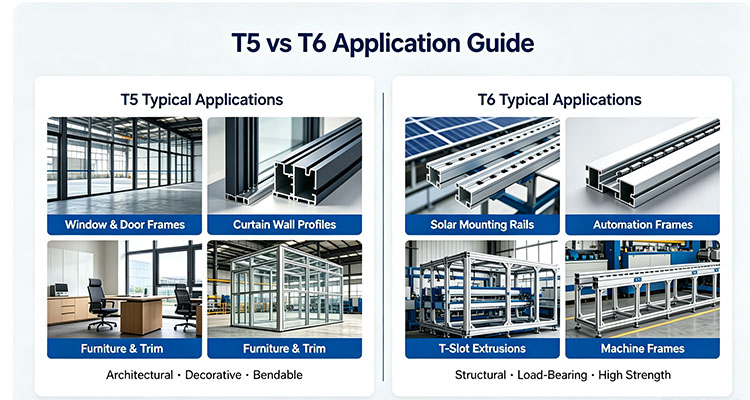
T5 is the workhorse of architectural aluminum. You'll find it in a wide range of applications where appearance and formability matter more than ultimate strength.-Window and door frames are the biggest T5 application by volume. More than 90 percent of aluminum windows use 6063-T5 profiles. It bends easily, anodizes beautifully, and has more than enough strength for holding glass.-Curtain wall systems — including mullions, transoms, and pressure plates — are almost exclusively T5 temper. The dimensional stability and consistent surface finish are critical for large building facades.-Aluminum furniture like table frames, chair legs, and office partition systems typically use T5 profiles. The smooth finish takes powder coating or anodizing well, and the material is easy to fabricate into furniture components.-Decorative trim and handrails are another common T5 application. Any application where appearance matters more than ultimate strength is a good fit for T5.-Lighting fixtures and heatsinks also often use T5. T5 has good thermal conductivity — slightly better than T6 — making it a solid choice for LED heatsinks and lighting housings.If you're in the architectural or fenestration industry, T5 is almost certainly your default. We've written more about the aluminum hard anodizing process for architectural projects if you want to dive deeper into surface treatments.
Where T6 Aluminum Is Used
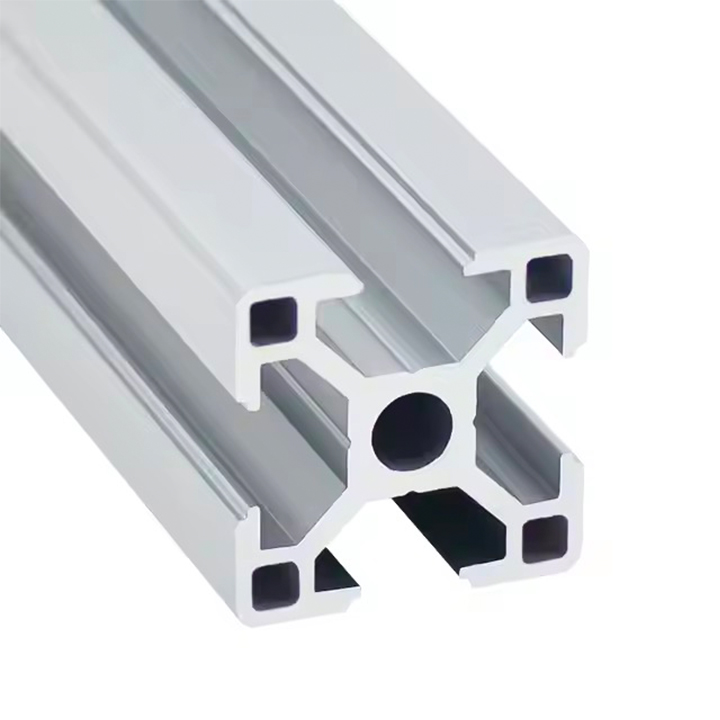
T6 is for when the part has to carry a load. It's the standard temper for structural and industrial applications.-Solar panel mounting frames and rails are one of the fastest-growing T6 applications. 6005A-T6 and 6061-T6 are the industry standard for solar mounting structures. They must resist wind uplift, snow load, and 25-plus years of outdoor exposure.-Industrial machine frames and guards rely on T6 extruded frames for rigidity. Automation equipment, packaging machines, and assembly lines worldwide use T6 aluminum framing systems.-T-slot aluminum extrusion systems — the modular framing systems used in factories — are almost always 6061-T6. The high strength and consistent dimensional properties make T6 the natural choice for these structural building systems.-Structural supports and brackets of all kinds use T6. Any component where deflection or yield strength is calculated by an engineer is almost certainly specified in T6 temper.-Transportation components like trailer frames, bus body structures, and railcar interior parts also frequently use T6 extrusions, where the strength-to-weight ratio is a key advantage.If your project involves structural calculations, load tables, or engineer-stamped drawings, T6 is almost certainly specified. Check out our guide on powder coating vs anodized aluminum for more on protecting structural T6 profiles in outdoor environments.How to Choose Between T5 and T6 Aluminum for Your Project
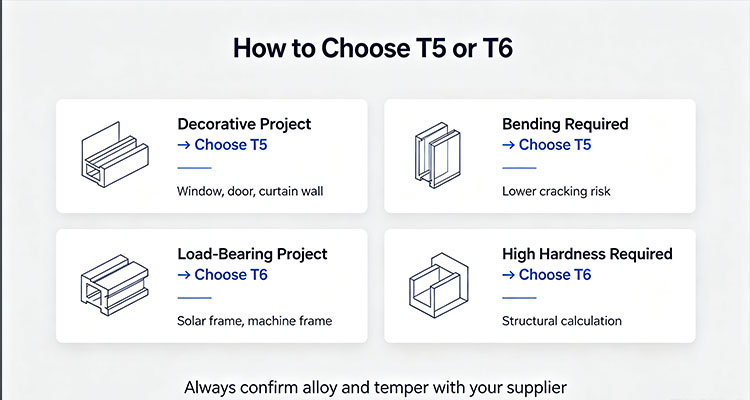
Still not sure? Run through this decision framework to find the right temper for your application.Step 1: Is It Structural or Decorative?
This is the fastest filter and gets you to the right answer most of the time.-If the part is decorative, architectural, or an enclosure, T5 is the right call. You'll get better surface finish, easier fabrication, and lower cost — with more than enough strength for the job. Windows, doors, curtain walls, furniture, and trim all fall into this category.-If the part is load-bearing, structural, or engineered, T6 is the standard. Don't try to substitute T5 to save money on structural parts — the safety margin isn't worth it. Solar mounting, machine frames, structural supports, and anything with engineer-stamped calculations all need T6.
Step 2: Will You Bend or Form the Profile?
Bending requirements are the second most important factor.-If yes, bending is required, go with T5 or T4. T6 and tight bends don't mix well. If the part needs to be formed after extrusion, T5 is the safe choice. For bent parts that also need strength, ask about T4 temper, which ages to near-T6 strength after forming.-If no bending is needed — just cutting and machining — T6 works fine. Straight profiles that get cut to length and drilled or milled work perfectly well in T6. Just be aware of residual stress if you're doing heavy machining on one side — the part may bow as stress is released.
Step 3: What's Your Budget & Lead Time?
Cost and schedule matter too. T6 costs more and takes longer — here's why.-T6 requires an additional solution heat treatment step before quenching, and water quenching lines are more expensive to run and maintain. T6 profiles often need stretching and straightening after quenching to control distortion. The overall production cycle is longer, which pushes lead times out.-For high-volume architectural projects like thousands of window profiles, switching from T6 to T5 — if appropriate for the application — can save 10 to 20 percent on material cost and cut lead time significantly. Always make sure the temper change is technically justified before making the switch.
Step 4: What Surface Finish Do You Need?
The surface treatment you plan to use can also influence the temper choice.-If you're going with anodized, decorative, or visible parts, T5 is preferred. T5 gives the most consistent, smooth anodized finish. If the aluminum will be seen and judged on appearance, go T5.-If you're going with powder coating, painting, or the part is hidden, either temper works. Powder coating covers up surface texture differences. If you're choosing between powder coating vs anodized aluminum and the part is structural, T6 plus powder coat is a great combination.Common Misconceptions About T5 and T6 Temper
Let's bust a few myths we hear all the time from new customers.
Myth 1: "T6 is always better than T5"
No, that's not right. "Better" depends on what you need. T6 is stronger, but T5 is more ductile, has better surface finish, costs less, and has lower residual stress. For windows and doors, T5 is the better choice — T6 would be overkill and more expensive for no benefit. The right temper is the one that meets your requirements at the lowest cost.
Myth 2: "You can't bend T6 aluminum at all"
Not exactly. You can bend T6, but the bend radius has to be much larger — typically three to five times the wall thickness or more — and there's always a risk of micro-cracks. For tight-radius bends, T5 or T4 is the right call. For gentle curves with large radii, T6 can work, but you should test first.
Myth 3: "T6 has better corrosion resistance"
Corrosion resistance primarily depends on the alloy, not the temper. 6063 and 6061 both have good atmospheric corrosion resistance regardless of temper. What does matter is surface treatment — anodized or powder coated profiles last far longer than bare aluminum, whether they're T5 or T6.
Myth 4: "All T6 is the same"
Nope, not even close. 6061-T6, 6063-T6, 6082-T6, and 6005A-T6 are all different materials with different strength levels. 6061-T6 is the strongest common 6xxx T6 alloy; 6063-T6 is weaker but extrudes finer details. Always confirm both alloy AND temper with your supplier — specifying just "T6 aluminum" isn't enough.Frequently Asked Questions About Aluminum T5 & T6 Temper
Is T6 aluminum stronger than T5?
Yes, significantly. 6061-T6 has roughly twice the yield strength of 6063-T5. Even comparing the same alloy — 6063-T5 versus 6063-T6 — T6 is about 30 to 40 percent stronger. The water quench plus solution heat treatment creates a much stronger, harder material. That's why structural parts always use T6.
Can we bend T6 aluminum profile?
T6 aluminum can be bent to large, gentle radii, but tight-radius bending frequently causes micro-cracks on the outer bend surface. For applications requiring formed or bent profiles, T5 temper is strongly recommended. If you need strength after bending, consider T4 temper, which bends well and naturally ages to near-T6 strength over time at room temperature.
What temper is best for window aluminum extrusions?
T5 temper — specifically 6063-T5 — is the global standard for window and door aluminum profiles. It offers the right balance of strength, excellent bendability, smooth surface finish for anodizing or powder coating, and cost-effectiveness. T6 would be overkill and more expensive for typical window applications, and the lower ductility would make bending more difficult.
What's the hardness difference between T5 and T6?
Measured on the Webster hardness scale, 6063-T5 typically reads 8 to 12 HW, while 6061-T6 reads 12 to 16+ HW. That's roughly a 30 to 50 percent hardness increase. Keep in mind that this comparison mixes alloys — 6063-T6 would be harder than 6063-T5 but softer than 6061-T6. Always compare the same alloy when evaluating temper differences.
Is T5 or T6 more expensive?
T6 aluminum profiles are 10 to 25 percent more expensive than equivalent T5 profiles. The price difference comes from the additional solution heat treatment step, water quenching infrastructure, longer production cycle, and additional straightening and quality control required for T6 material. For projects where T5 is technically sufficient, sticking with T5 can deliver meaningful cost savings.
Can T6 aluminum be anodized?
Yes, T6 aluminum can be anodized, and it's commonly done for outdoor structural applications like solar panel mounting aluminum frame. However, T6 profiles may have a slightly rougher surface after water quenching, and achieving perfectly uniform cosmetic anodizing can be more challenging than with T5. For purely decorative anodized parts where appearance is critical, T5 is usually preferred.Get Custom T5/T6 Aluminum Profile From Our Factory
Choosing the right temper is just the first step. Whether you need 6063-T5 window profiles with a smooth anodized finish or 6061-T6 structural extrusions for solar mounting systems, Leader Aluminum has the extrusion capacity, heat treatment lines, and surface treatment capabilities to deliver on spec and on time.
What we offer
We provide a full range of alloy options including 6063, 6061, 6005A, 6082, and custom 6xxx series alloys to match your specific requirements.-For tempers, we offer T5, T6, T4, T66, and T651 — all matched to your application and performance needs. Our engineering team can help you select the optimal temper if you're not sure which one is right for your project.On surface treatments, we provide anodizing in clear, black, and custom colors; powder coating in any RAL color; wood grain transfer; polishing; and sandblasting. Whatever finish your project requires, we can deliver it.-For custom extrusion, just send us your drawing. We can extrude profiles from 10mm to 400mm wide, up to 6 meters long, with complex cross-sections and tight tolerances.We also offer comprehensive fabrication services including cutting, drilling, milling, bending, tapping, and assembly — delivering ready-to-install parts straight to your facility.If you're working on a project and not sure whether T5 or T6 is right for your design, send us your drawing and application details. Our engineering team will recommend the optimal alloy, temper, and surface treatment — and provide a competitive factory quote within 24 hours.Ready to get started? Contact our sales team today with your project requirements, and let's make your aluminum extrusion project a success.

Foshan Aluleader Metal Materials Co.,Ltd. (OEM&ODM)
is a comprehensive enterprise with over 15 years experence,engaging in the design, production and sales of aluminum profiles.Learn more...
If you have any question, feel free to contact us, Thank You !
Whatsapp: +8619867251009 Email: [email protected]