Welcome to Aluleader Metal
Large-Section Aluminum Extrusion Design: A Guide for Complex Hollow Profiles | Aluleader
In high-end manufacturing sectors such as new energy, rail transportation, heavy machinery, and aerospace, the demand for large-section, complex hollow aluminum extrusions is growing rapidly. These profiles are not just structural components; they are system-level engineering parts that integrate lightweighting, thermal management, sealing, and load-bearing functions. However, producing these profiles presents significant challenges: high extrusion pressure requirements, complex metal flow control, and the delicate balance between die life and product quality.
This guide provides a systematic overview of the design, extrudability assessment, and strategies for maximizing large extrusion press capabilities.
Part 1: Press Capability and Profile Size Limits
The foundation of producing large-section profiles is access to an extrusion press with sufficient tonnage. Equipment capability directly determines the maximum circumscribing circle diameter (CCD), unit weight, and applicable alloy range of the profile.
The Real Meaning of Press Tonnage
The nominal tonnage of an extrusion press (e.g., 4,000T, 8,000T) represents its maximum extrusion force. However, tonnage alone is a threshold condition. What matters for engineering is specific pressure—the extrusion force per unit area of the billet cross-section.
Typical Correspondence Between Tonnage and Profile Size:
4000T-class presses: Can stably extrude billets of 300mm diameter and above, with maximum CCD up to 350-420mm, and single billet weight approximately 1.2 tons.
8000T-class presses: Can extrude ultra-large profiles with a CCD reaching 800mm.
10000T-class presses: Can handle billets of 16-inch or even 20-inch diameter, with maximum CCD up to 31 inches (approximately 787mm).
The Strategic Value of Ultra-Large Presses
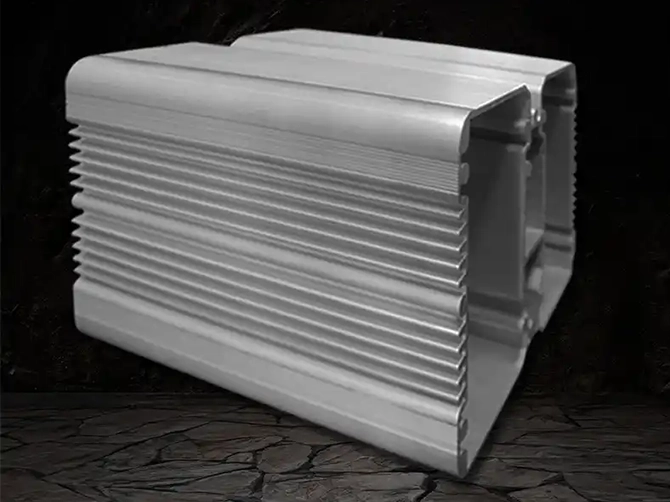
A 225MN (approximately 22,500 tons) horizontal aluminum extrusion press can produce wide integrally stiffened panels up to 1690mm in width. This capability replaces traditional welded assemblies with a single formed component, reducing welds by up to 60% and significantly improving corrosion resistance and service life. This capability has strategic importance in aerospace, shipbuilding, and rail transportation.
Part 2: Key Design Principles for Large-Section Profiles
Considering the constraints of the extrusion process during the design phase is critical for reducing production costs, ensuring product quality, and maximizing equipment utilization.
1. Cross-Section Design and Extrudability
Pursue Integrated Design: The core advantage of large-section profiles is consolidating multiple small components into a single extrusion, reducing weld points and improving structural strength. Evaluate which structures can be integrated during design.
Control Wall Thickness Uniformity: Rapid changes in wall thickness cause uneven metal flow, increasing distortion and residual stress. Design should ensure smooth transitions, with adjacent wall thickness ratios kept as low as possible.
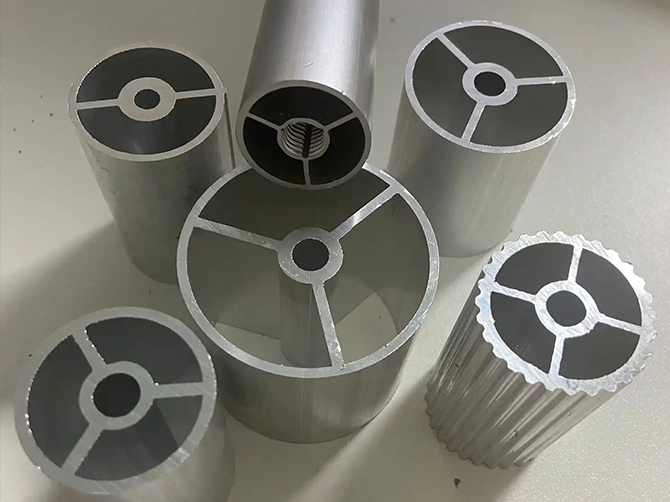
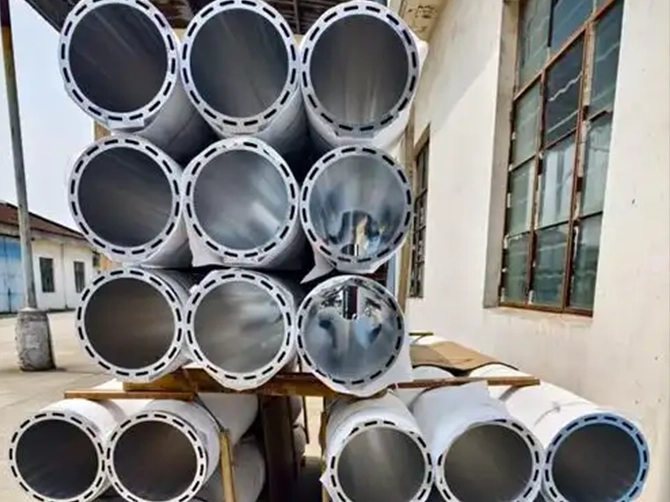
Optimize Cavity Layout: Multi-cavity hollow profiles are common products for large presses. The number, position, and shape of cavities directly affect die strength and metal flow. Reduce unnecessary complex cavities and ensure the die bridges supporting the mandrel have sufficient strength.
Optimize Radii: Sharp internal corners significantly increase stress concentration and reduce die life. Increase corner radii wherever possible.
2. Alloy Selection and Extrudability
An alloy's flow stress determines its extrusion difficulty.
6063 and similar 6xxx alloys have good flow characteristics and are relatively easy to extrude.
6061, 6082 and other higher-strength 6xxx alloys require higher extrusion pressure.
7075, 2024 and other high-strength 7xxx and 2xxx alloys have high flow stress, demanding exceptional specific pressure and temperature control from the press.
For large-section profiles, prioritize alloys with good extrudability that meet performance requirements. If difficult-to-extrude alloys are necessary, fully assess press capability and die design.
3. Die Design: The Core Technology
The die is central to extrusion success. For large-section profiles, die design faces multiple challenges: metal flow uniformity, weld quality, and die life.
Metal Flow Uniformity: Uneven exit velocity is the primary cause of profile distortion and dimensional deviation. Finite element simulation is essential to analyze metal flow and optimize the porthole shape and bearing length distribution.
Weld Quality Control: Hollow profiles inevitably have longitudinal weld seams where metal streams rejoin in the weld chamber. Simulation and experiments confirm that good weld quality can be achieved after a certain distance from the profile front. Die design must ensure sufficient pressure in the weld chamber.
Die Life Extension: Large-section dies endure tremendous stress. Innovative structures, such as arc-entry designs, can significantly reduce die stress without affecting metal flow, extending die working life. Multi-billet extrusion technology, where multiple smaller billets are simultaneously fed into a single weld chamber, reduces the required extrusion force to approximately 15% of that needed by conventional methods.
Part 3: Maximizing Large Extrusion Press Capability
Owning a large press is only the first step. The core challenge is using its capability efficiently, stably, and with high quality.
1. Advancing Process Control
Large presses have high inertia and are difficult to control thermally; they directly determine yield and product quality.
Intelligent Speed Control: Coordinated multi-parameter control of extrusion speed ensures stable operation across the entire speed range, improving yield and reducing energy consumption.
Precise Temperature Control: Uniform container temperature, achieved through "multi-zone partitioned heating with circulating air cooling" and intelligent PID control, prevents localized overheating, extends equipment life, and ensures product stability.
Intelligent Die Cooling: Using liquid nitrogen die cooling with intelligent algorithms to dynamically regulate spray volume precisely controls die temperature, prevents surface oxidation, and extends die life.
2. Integrated and Automated Production Lines
Large presses are rarely standalone. Integrating automated billet heating, quick die change systems, online precision straightening, online quenching, and downstream sawing into a single production line is essential for continuous, stable, and efficient production. Automation reduces product changeover time, accommodating mixed production runs.
3. Thinking Beyond Tonnage: Utilizing Special Container Technologies
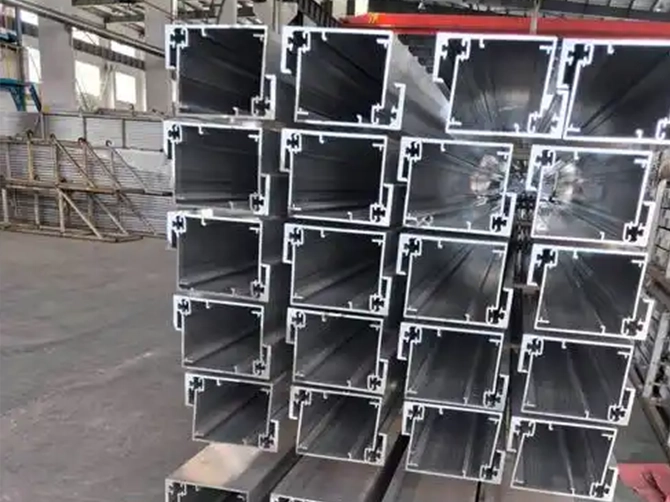
Traditional extrusion presses use round containers. However, innovative rectangular container technology allows for extruding wider, flatter profiles than conventional round containers—up to 31 inches in width. This technology improves efficiency and reduces waste for wide panels and large hollow profiles, offering new design possibilities.
Frequently Asked Questions (FAQ)
Q: How do I know if my profile design is suitable for a large extrusion press?
A: The key is assessing whether the CCD and the alloy's flow stress are within the press's capability. The most reliable method is consulting with an experienced extruder during the design phase; they can use finite element simulation to assess feasibility.
Q: Why are dies for large-section profiles so expensive?
A: They require higher-grade tool steel, must withstand greater stress, are more complex in design (e.g., multi-porthole, complex weld chambers), and demand extremely high manufacturing precision.
Q: Will using a large press always lower my overall cost?
A: Not necessarily. It is economical for high-volume, large-section, complex, integrated components. For small batches, simple sections, or small profiles, a smaller press may be more cost-effective. Value is realized through replacing welded assemblies, reducing downstream operations, and improving structural integrity.
Q: Must all large profiles "fill" the press in terms of size?
A: No. Another value of large presses is the ability to extrude hard alloys efficiently. Even if the profile's CCD is not maximum, using a large press provides the necessary specific pressure for difficult-to-extrude alloys like 7075.
Related Posts
CNC Machining Aluminum Extrusions: Ultimate Guide — Understand post-extrusion precision machining to add features to large profiles.
Aluminum Welding Guide — Learn how integrated extrusion reduces welding requirements for large-section components.
Aluminum Profile Connection Technologies — Compare different joining methods, highlighting the advantages of integrated extrusions.
Extruded Aluminum vs Die Cast: Comparison Guide — Understand why extrusion is the preferred process for large structural components.
Aluminum Extrusion in Modular Construction — Explore integrated applications of large profiles in the building sector.
About Aluleader
With over 15 years of experience in the aluminum extrusion industry, Aluleader provides high-quality architectural profiles,industrial profiles, and furniture/decorative profiles. While we currently focus on medium and precision profiles, we maintain close partnerships with industry-leading equipment manufacturers and technology partners. This enables us to provide preliminary consulting and supply chain integration for customers with large-section profile projects. For specific large-profile inquiries, our engineering team can assist with feasibility assessments and recommend suitable manufacturing resources.