Welcome to Aluleader Metal
Aluminum Enclosure IP Rating Guide: Complete Selection Guide for Engineers | Aluleader
In the electronics and electrical industries, an enclosure is more than just a box—it is the first line of defense protecting sensitive components from environmental threats. Choosing the wrong enclosure can lead to premature equipment failure, safety hazards, and costly downtime.
This guide provides a comprehensive overview of IP (Ingress Protection) ratings for aluminum enclosures, helping engineers and procurement professionals make informed decisions for their projects. At Aluleader, with extensive experience manufacturing architectural profiles, industrial profiles, and furniture/decorative profiles, we understand the critical role that precision-engineered aluminum enclosures play in protecting electronic systems across diverse applications.
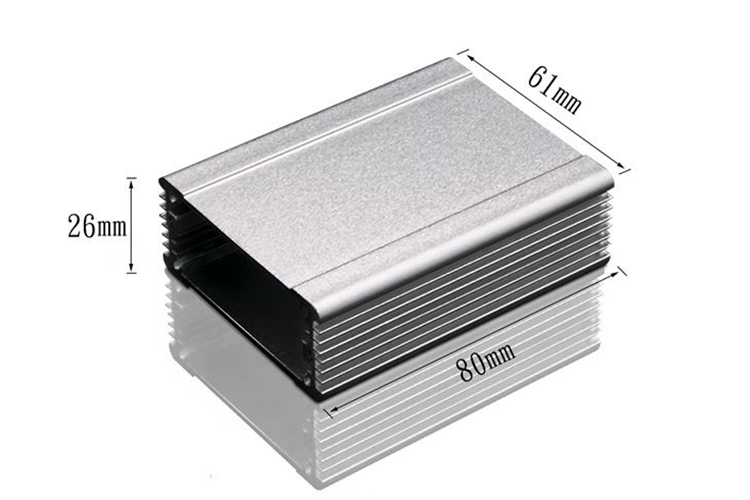
What Are IP Ratings?
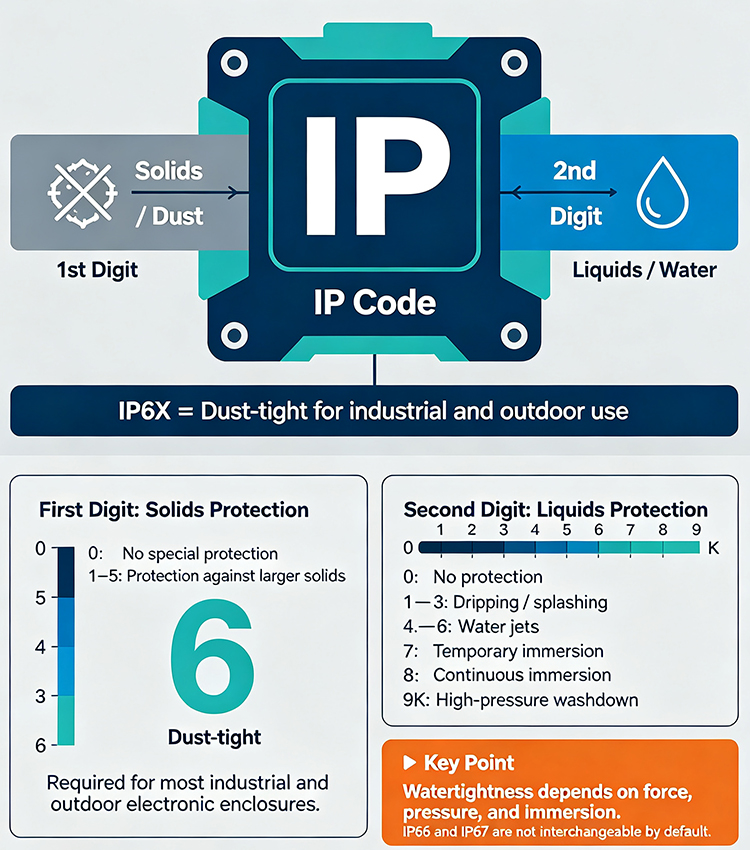
IP (Ingress Protection) ratings are an international standard defined by IEC 60529 (and its European equivalent EN 60529) that classifies the degree of protection provided by enclosures against the intrusion of solid objects, dust, and water. The rating consists of two letters—IP—followed by two digits: the first for solids protection, the second for liquids protection.
Understanding the First Digit: Solids Protection
The first digit ranges from 0 to 6. Level 6 represents the highest level of dust protection, meaning the unit is completely dust-tight. For electronic enclosures used in industrial or outdoor environments, the first digit should always be 6—nothing less will suffice. This ensures protection against all airborne dust, sand, dirt, and debris.
Understanding the Second Digit: Liquids Protection
The second digit ranges from 0 to 9K. Higher numbers do not always mean "better" in absolute terms—they indicate different levels of protection against specific conditions. An enclosure rated IP66 can withstand powerful water jets but may not necessarily survive immersion, whereas an IP67 enclosure can survive temporary immersion but may have different characteristics for jet protection.
Key distinction: Watertightness is not a binary concept. It depends on factors such as force, pressure, and whether the enclosure must survive immersion.
Common IP Ratings for Aluminum Enclosures
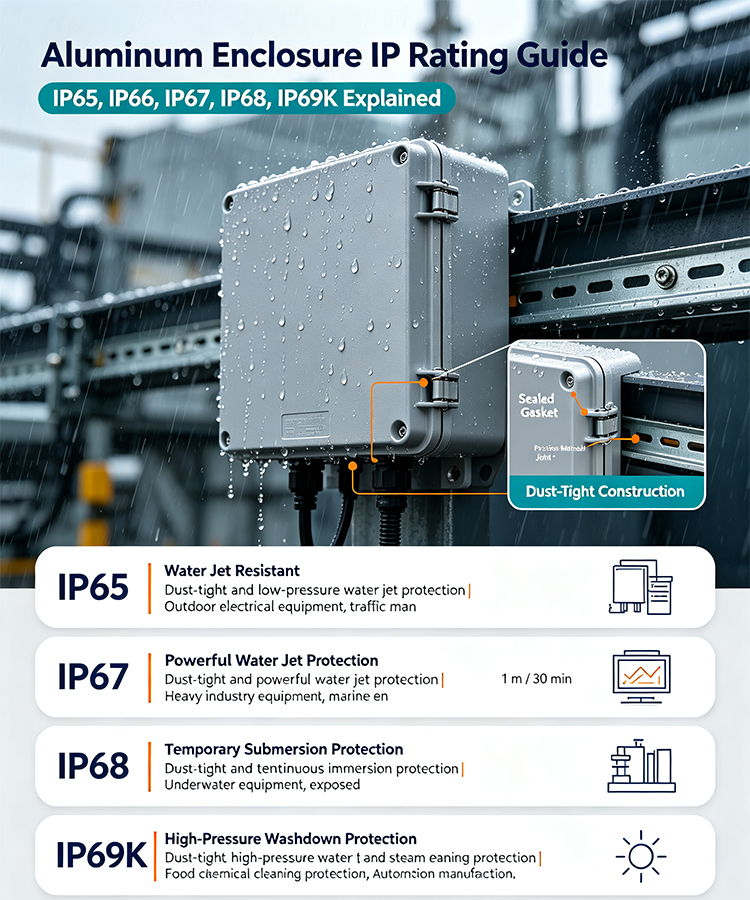
IP65 — Water Jet Resistant
IP65 provides dust-tight protection (first digit 6) and protection against low-pressure water jets from any direction (second digit 5). This is typically considered the minimum rating for "watertight" enclosures. IP65 works well when water exposure is expected but immersion is unlikely.
Typical Applications: Outdoor electrical equipment, traffic management systems (arrow boards, VMS), outdoor enclosures where cost and ease of installation matter.
IP66 — Powerful Water Jet Protection
IP66 offers dust-tight protection and protection against powerful water jets—specifically, 100 liters of water per minute at a pressure of 100 kPa from a distance of three meters. This rating is suitable for marine environments, outdoor industrial equipment, and heavy-duty applications where equipment may be exposed to heavy rain or hose-directed cleaning.
Typical Applications: Heavy industry equipment, marine environments, high-pressure factory washdown areas.
IP67 — Temporary Submersion Protection
IP67 provides dust-tight protection and protection against temporary immersion in water—up to 1 meter depth for at least 30 minutes. This is often considered the "gold standard" for outdoor electronics, protecting against everything from desert dust to sudden rainstorms or flooding.
Typical Applications: Outdoor electronics, automotive exteriors, marine dashboards, equipment that may experience brief flooding or heavy washdown.
IP68 — Prolonged Submersion Protection
IP68 offers dust-tight protection and protection against continuous immersion in water under conditions specified by the manufacturer. Unlike IP67, IP68 does not have a fixed depth or duration—these values are specified by the manufacturer. This is the highest waterproof rating for connection and enclosure products.
Typical Applications: Underwater equipment, exposed marine systems, environments where standing water is part of normal operation.
IP69K — High-Pressure Washdown Protection
IP69K provides dust-tight protection and protection against high-pressure water jets and steam cleaning. This is the highest IP rating commonly available and is used in applications requiring frequent washdowns.
Typical Applications: Food processing, chemical production, agriculture, automotive manufacturing.
Why Choose Aluminum for Electronic Enclosures?
Aluminum is one of the most popular materials for electronic enclosures, offering a unique combination of properties that make it superior to plastics and other metals for many applications.
Natural EMI/RFI Shielding
Unlike plastic enclosures, which can act as "windows" for electromagnetic interference, aluminum provides natural electromagnetic and radio-frequency interference shielding. This makes aluminum the ideal choice for communications equipment, sensitive industrial control systems, and any application where signal integrity is critical.
Superior Impact Resistance
Aluminum offers superior impact resistance compared to plastics. A die-cast aluminum enclosure typically achieves IK08 or higher impact rating, meaning it can withstand significant kinetic energy from tools, falling debris, or accidental collisions. Plastic housings are susceptible to cracking under physical stress.
Thermal Management
IP-rated aluminum enclosures are effectively sealed, which can create an "oven effect" where heat from internal components is trapped. Aluminum's inherent thermal conductivity—approximately 200–218 W/m·K—helps dissipate heat through the enclosure walls, preventing overheating of sensitive electronics. For high-temperature applications, designs may incorporate internal heatsinks or mount components directly to the enclosure wall to leverage this conductivity.
Corrosion Resistance
Aluminum forms a thin, naturally occurring protective oxide film that resists corrosion. This resistance can be further enhanced through anodizing or powder coating. However, for harsh marine environments or chemical exposure, additional corrosion protection should be considered.
Lightweight Yet Strong
Aluminum combines excellent strength-to-weight ratio—approximately one-third the density of steel—making it suitable for applications where weight is a consideration.
Extruded Aluminum vs. Die-Cast Aluminum Enclosures
Both extruded and die-cast aluminum are used for electronic enclosures, but they have distinct characteristics:
Extruded Aluminum Enclosures
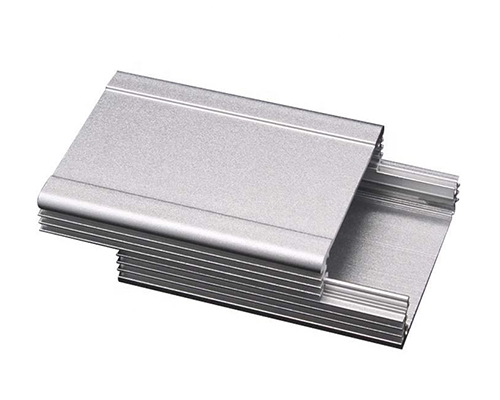
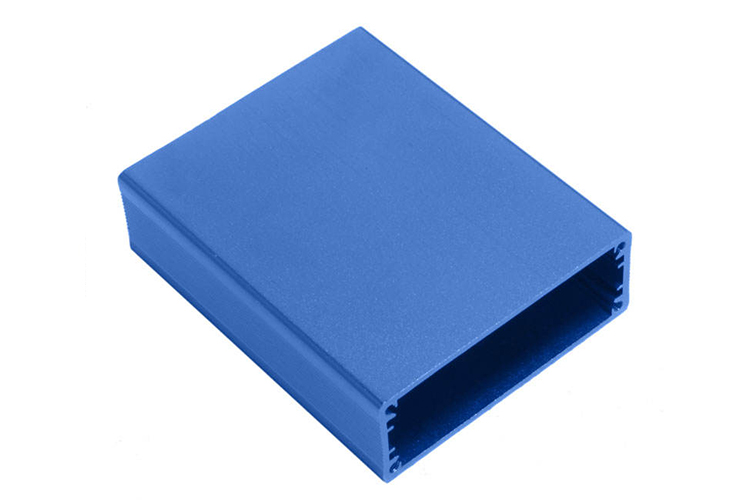
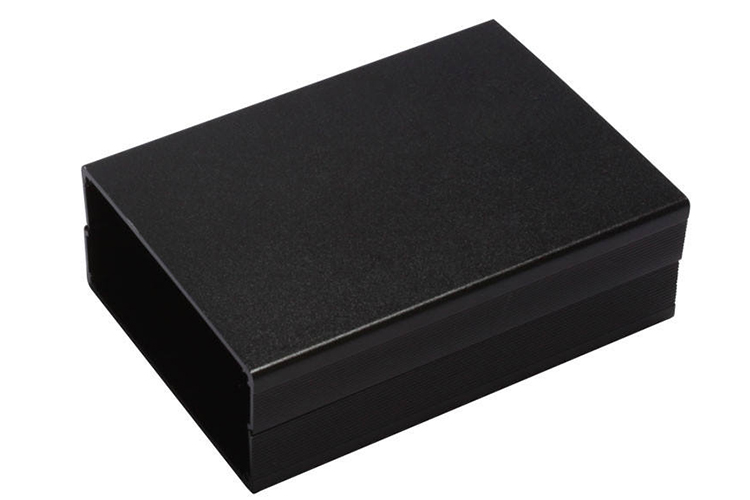
Extruded enclosures are formed from a single, continuous extrusion with internal slots for PCB mounting. The extrusion process allows for excellent straightness and uniform wall thickness.
Advantages: Cost-effective for longer profiles, can include integrated features like recessed areas for labels or membrane keypads, lighter weight, design flexibility.
Typical IP Ratings: IP54 to IP65. The 1457 series from Hammond, for example, is sealed to IP65 with die-cast aluminum end panels and self-adhesive gaskets.
Applications: General-purpose electronics, industrial control equipment, rack-mount systems, desktop instruments.
Die-Cast Aluminum Enclosures
Die-cast enclosures are cast as a single piece with thick walls for enhanced durability. The die-casting process allows for complex 3D geometries with ribs, bosses, and mounting features integrated directly into the design.
Advantages: Higher impact resistance (IK08+), can achieve higher IP ratings (IP66, IP67, IP68, IP69K), excellent for harsh environments, thick-walled construction for maximum protection.
Typical IP Ratings: IP66, IP67, IP68, IP69K.
Applications: Marine instrumentation, outdoor industrial controls, heavy machinery, food processing equipment, high-traffic industrial areas.
NEMA Ratings: The North American Equivalent
While IP ratings are international, North American applications often reference NEMA (National Electrical Manufacturers Association) enclosure types. Key equivalencies include:
NEMA 4/4X ≈ IP66: Protection against rain, sleet, snow, splashing water, and hose-directed water; NEMA 4X adds corrosion resistance
NEMA 6/6P ≈ IP67/IP68: Protection against temporary (6) or prolonged (6P) submersion
NEMA 12/13 ≈ IP54-IP65: Indoor use, dust, dirt, non-corrosive liquids; NEMA 13 adds oil and coolant protection
Most aluminum enclosures from reputable manufacturers are tested and certified to both IP and NEMA standards.
Application-Specific Selection Guide
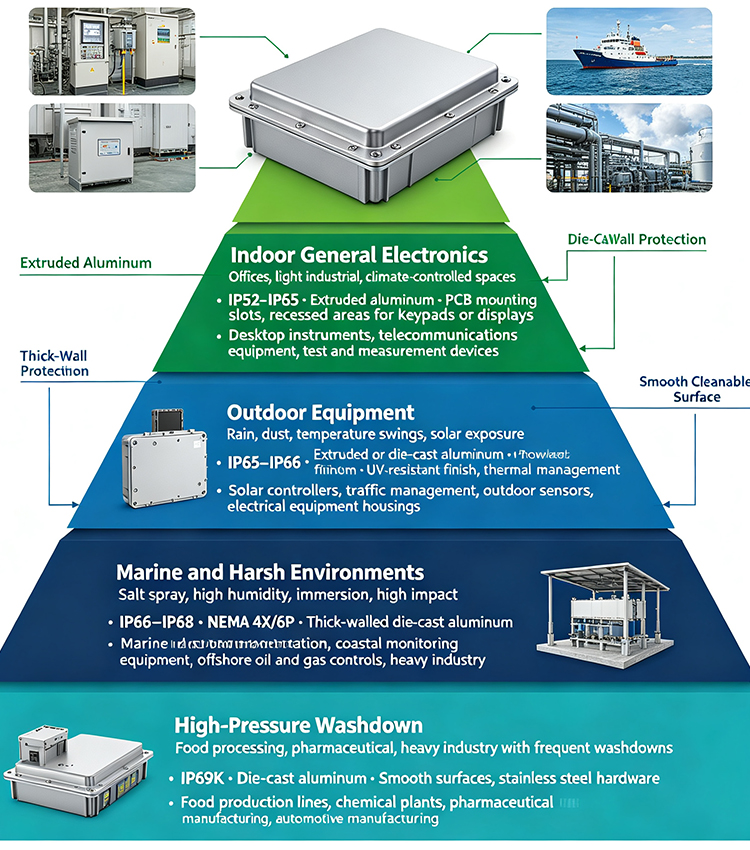
Indoor General Electronics (IP54-IP65)
Environments: Offices, light industrial, climate-controlled spaces.
Recommended: Extruded aluminum enclosures with IP54 or IP65 ratings. Features should include PCB mounting slots, recessed areas for keypads or displays.
Typical Applications: Desktop instruments, telecommunications equipment, test and measurement devices.
Outdoor Equipment (IP65-IP66)
Environments: Rain, dust, temperature swings, solar exposure.
Recommended: Extruded or die-cast aluminum with IP65 or IP66 rating. Consider UV resistance of the finish and thermal management to handle solar heat loading.
Typical Applications: Solar controllers, traffic management, outdoor sensors, electrical equipment housings.
Marine and Harsh Environments (IP66-IP68)
Environments: Salt spray, high humidity, immersion, high impact.
Recommended: Thick-walled die-cast aluminum with IP66/67/68 and NEMA 4X/6P. Corrosion-resistant alloys with powder-coated or anodized finishes provide necessary protection.
Typical Applications: Marine instrumentation, coastal monitoring equipment, offshore oil and gas controls, heavy industry.
High-Pressure Washdown (IP69K)
Environments: Food processing, pharmaceutical, heavy industry with frequent washdowns.
Recommended: Die-cast aluminum with IP69K rating. Smooth surfaces to prevent bacterial growth, stainless steel hardware are additional considerations.
Typical Applications: Food production lines, chemical plants, pharmaceutical manufacturing, automotive manufacturing.
Important Design Considerations
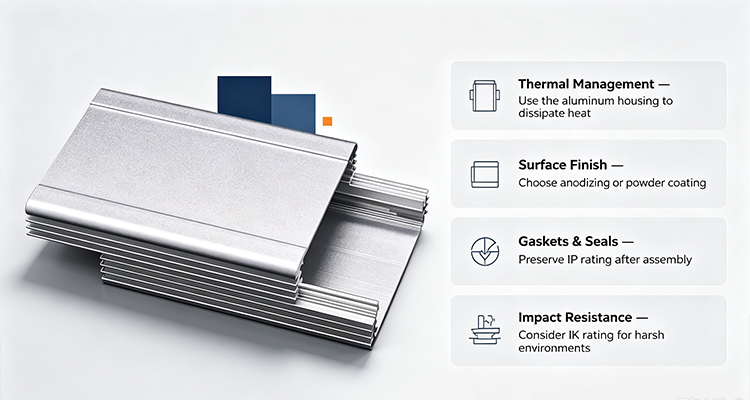
Thermal Management
With IP-rated enclosures being effectively sealed, internal heat management is critical. Strategies include:
Selecting enclosures with adequate internal volume for air circulation
Using the aluminum body itself as a heatsink through direct component mounting
Incorporating internal heatsink features where available, such as the 1455HD series which features additional surface area in the extrusion to provide increased heat dissipation
Surface Finish
Surface finishes affect both corrosion resistance and dimensional tolerances:
Anodizing: Adds corrosion and wear resistance; maintains metallic appearance; slight dimensional increase
Powder Coating: Provides excellent corrosion protection and color options; adds thickness (outer dimensions increase)
Clear Anodized Finish: Available as standard on many extruded enclosures for corrosion protection while maintaining aesthetic appearance
At Aluleader, we offer custom-extruded aluminum enclosures with precise tolerances and a variety of surface finishing options to meet specific IP and aesthetic requirements, including anodized and powder-coated finishes.
Gaskets and Seals
Achieving and maintaining IP ratings depends heavily on gasket quality. Common materials include:
Closed-cell polyethylene foam: Standard for many extruded enclosures
Silicone: Excellent temperature and UV resistance
Self-adhesive gaskets: Used on enclosures like the 1457 series to provide IP65 sealing
Gaskets should be inspected periodically and replaced if signs of wear, compression set, or damage are observed.
Machining and Assembly
Important caution: IP ratings are typically tested on unmodified enclosures. Drilling, cutting, or machining the enclosure for cable entries, connectors, or displays can compromise the IP rating unless proper sealing measures are taken at all modified points. Always plan for cable glands, conduit fittings, or custom seals that maintain the required rating.
Impact Resistance: IK Ratings
Beyond IP ratings, consider IK impact ratings (IEC 62262). These range from IK00 (no protection) to IK10 (protection against 20J impact, equivalent to a 5kg mass dropped from 400mm height), with IK11 added in 2021 for 50J protection. For most industrial applications, IK07 or IK08 is typically sufficient. Die-cast aluminum enclosures generally achieve IK08 or higher.
Frequently Asked Questions (FAQ)
Q: What is the difference between IP65, IP67, and IP68?
A: IP65 protects against water jets from any direction; IP67 protects against temporary immersion in water (up to 1 meter for 30 minutes); IP68 protects against prolonged immersion under conditions specified by the manufacturer. For outdoor applications with possible standing water or submersion, choose IP67 or IP68.
Q: Can I machine an IP-rated aluminum enclosure without losing its rating?
A: Yes, but proper precautions are required. Use certified cable glands, conduit fittings, or custom sealing methods at all entry points. The enclosure's original rating applies only to the unmodified unit.
Q: Are aluminum enclosures corrosion-resistant in saltwater environments?
A: Aluminum has natural corrosion resistance, but for marine or coastal environments, choose thick-walled die-cast aluminum enclosures with appropriate surface treatments such as powder coating or anodizing.
Q: Which is better for electronic enclosures—extruded or die-cast aluminum?
A: Extruded aluminum is cost-effective for standard profiles with consistent cross-sections and typical IP ratings up to IP65. Die-cast aluminum offers higher impact resistance (IK08+) and can achieve higher IP ratings (IP66, IP67, IP68, IP69K), making it preferred for harsh environments.
Q: What is the IK impact rating, and how does it relate to IP rating?
A: IK rating (IEC 62262) measures mechanical impact resistance independently from IP rating. Many die-cast aluminum enclosures achieve IK08 or higher, meaning they can withstand significant impacts without failing—critical for high-traffic industrial areas.
Q: How does aluminum compare to plastic for electronic enclosures?
A: Aluminum offers superior EMI/RFI shielding, better thermal management, higher impact resistance (IK08+ vs IK07 for many plastics), and greater durability compared to plastic. Plastic enclosures are lighter and often less expensive, but lack the conductive properties and heat dissipation capabilities of aluminum. For Wi-Fi and IoT sensors, polycarbonate is often preferred because it is RF-transparent and does not interfere with wireless signals.
Related Posts
Extruded Aluminum vs Die Cast: Comparison Guide — Understand the fundamental differences between these two manufacturing processes.
Surface Finishing Options for Aluminum Extrusions — Explore anodizing, powder coating, and other finishes for corrosion protection and aesthetics.
11 Silent Quality Traps in Aluminum Extrusion and How to Avoid Them — Learn about common defects and quality control practices.
Aluminum Extrusion Process: 11 Key Steps Explained — A comprehensive walkthrough from billet heating to final aging.
Applications of Aluminum Extrusion in Different Industries — Explore how extrusion is used across electronics, automotive, construction, and more.
About Aluleader
With over 15 years of experience in the aluminum extrusion industry, Aluleader provides high-quality architectural profiles, industrial profiles, and furniture/decorative profiles. Our integrated capabilities—from die design and extrusion to CNC machining, surface finishing, and fabrication—ensure consistent quality across every project.
For customers in the electronics and electrical industries, we offer custom-extruded aluminum enclosures and structural profiles with precise tolerances and a variety of surface finishing options to meet specific IP and aesthetic requirements. Our standard enclosure profile materials include 6063-T5 for excellent corrosion resistance and extrudability, and 6061-T6 for applications requiring higher structural strength.
For project-specific questions or detailed inquiries about our enclosure and profile capabilities, our engineering team is available to provide technical guidance.