Welcome to Aluleader Metal
Aluminum vs. Wood: Complete Comparison for Construction & Furniture | Aluleader
Choosing between aluminum and wood is a decision that has shaped architecture, furniture design, and manufacturing for generations. Each material brings distinct properties, advantages, and limitations that profoundly influence project outcomes. While wood offers natural beauty and tradition, aluminum delivers engineering precision and durability that often surpasses organic materials across critical performance metrics.
This guide provides a comprehensive comparison of aluminum and wood across multiple dimensions: structural performance, durability, maintenance, cost, environmental impact, and aesthetic considerations. Drawing on industry data and technical analysis, it helps designers, engineers, and procurement professionals make informed material choices for their specific applications.
Structural Strength and Performance
Strength-to-Weight Ratio
Aluminum offers exceptional strength-to-weight performance. The Aluminum Extruders Council notes that aluminum extrusions have very good mechanical properties while weighing approximately one-third as much as steel and about 60% as much as molded plastics . By comparison, wood has about one-third the density of aluminum, meaning it is lighter but also significantly weaker for the same volume .
In camper van construction, this difference is dramatic. Builds using aluminum cabinetry and structural modules consistently come in over 1,000 pounds lighter than comparable wood-heavy vans . Reduced weight translates to improved fuel efficiency, better off-road performance, reduced drivetrain strain, and increased payload capacity for gear and water .
Dimensional Stability
Aluminum maintains its shape and dimension over time. It does not shrink, expand, warp, or split . Wood, by contrast, responds to humidity changes by expanding and contracting. This natural movement can loosen fasteners, cause joints to fail, and create gaps over time . For precision applications like window frames, industrial equipment, or high-tolerance assemblies, aluminum's dimensional stability is a critical advantage.
Durability and Longevity
Resistance to Rot, Mold, and Pests
Aluminum cannot rot and does not support mold growth. It has a natural oxide coating that protects it from degradation . Wood, however, is susceptible to rot, mold, and insect infestation, particularly in moist environments. In deck substructures, wooden beams can deteriorate within 10 to 15 years without careful protection against waterlogging and proper ventilation .
Corrosion Resistance
Aluminum forms a thin, naturally occurring, impenetrable protective oxide film that resists corrosion . This resistance can be further enhanced through anodizing or powder coating . Wood has no inherent corrosion resistance and can degrade through chemical attack from acids, salts, and environmental pollutants.
Weather and UV Resistance
Aluminum alloys in the 6xxx series are far more resistant to rain, snow, and UV rays than wood . While wood weathers and can develop a silvery patina, it may also crack and fade if neglected. Aluminum's resistance to weathering makes it the preferred material for outdoor structures like docks, pergolas, and building facades .
Impact and Fatigue Resistance
In demanding applications like camper vans subject to off-road abuse, aluminum demonstrates excellent vibration, corrosion, and temperature tolerance . Wood under similar conditions is more prone to fastener loosening, cracking, swelling, and finish fatigue. Aluminum profiles can be engineered to withstand significant structural loads while maintaining integrity over thousands of miles of vibration.
Maintenance Requirements
Low-Maintenance Nature of Aluminum
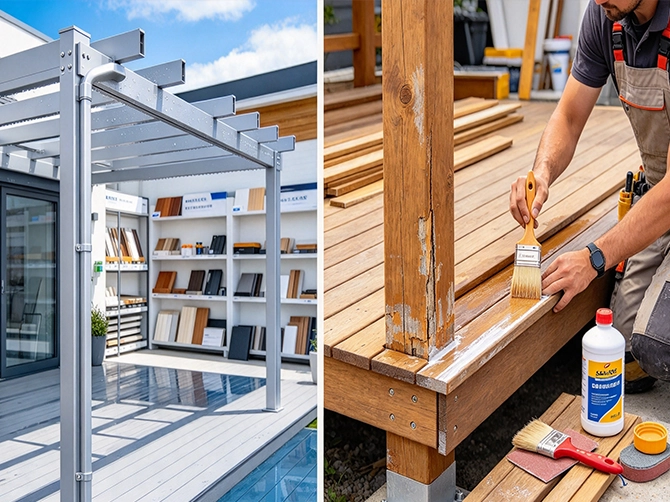
Aluminum requires minimal maintenance. It never needs scraping, sanding, painting, or staining . For outdoor applications like pergolas and deck substructures, aluminum can simply be hosed off occasionally to restore its appearance . In dock construction, aluminum's low maintenance translates to "additional savings over the life of the structure" .
Wood's Ongoing Care Demands
Wood demands ongoing care to maintain appearance and structural integrity. Pergolas, decks, and furniture made of wood typically require resealing or staining every few years . For window frames, wood's maintenance requirements—regular painting or sealing—add to lifecycle costs . In decking applications, wooden substructures can require repair or replacement of individual rails, driving long-term maintenance expense .
Long-Term Cost Considerations
While wood may have a lower initial material cost, aluminum often proves more economical over the lifecycle . Aluminum substructures for decking can be disassembled and reused, eliminating the need for regular replacement. As one manufacturer notes, "a simple comparison of the unit price is simply not meaningful enough to choose the cheapest overall option for the desired quality standard" .
Environmental Impact and Sustainability
Embodied Energy and Production Impacts
The production of aluminum is energy-intensive. Research on window frames found that aluminum has "high values of embodied energy and associated environmental impacts" . Timber, by contrast, has low embodied energy and is considered a sustainable product with environment-friendly characteristics .
This difference reflects the fundamental nature of the materials: aluminum is a manufactured metal requiring significant energy for extraction and processing; wood is a renewable resource that sequesters carbon during growth.
Recycling and Circular Economy
Aluminum's environmental profile is transformed by its recyclability. Aluminum is infinitely recyclable without losing its properties . Scrap aluminum has high value and is routinely reprocessed to generate new extrusions . For window frames, aluminum recycling rates are high (approximately 90%), with significant environmental benefits over the full building lifetime .
Wood has low scrap value and cannot be recycled in the same closed-loop manner . While it can be incinerated for energy recovery or composted, it does not offer the same circular economy potential as aluminum.
Carbon Footprint Trade-Offs
The choice between aluminum and wood involves complex carbon trade-offs. Wood offers lower embodied energy, but aluminum's durability and recyclability can reduce environmental impacts over a building's lifetime . A lifecycle analysis of window frames over an 80-year building lifetime found that durability and replacement cycles significantly influence overall impacts .
The emergence of wood-steel hybrid battery housings for electric vehicles highlights how wood can be strategically paired with metals to reduce environmental impact while maintaining structural performance .
Aesthetic and Design Considerations
Natural Beauty vs. Modern Precision
Wood is prized for its organic warmth, natural grain, and timeless character. In pergola construction, wood creates a "grounded and natural" feel that aluminum cannot replicate . In furniture and cabinetry, wood's aesthetic warmth is often considered unmatched.
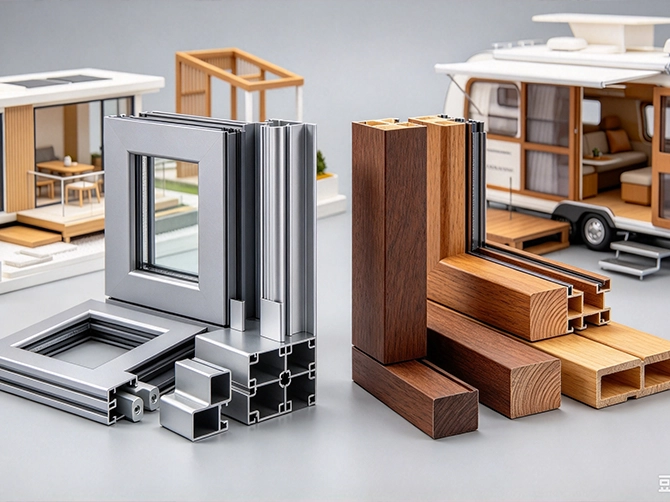
Aluminum offers a clean, architectural look that pairs well with modern and minimalist designs. Powder-coated finishes are available in thousands of colors, including metallic, matte, and textured options . Aluminum can also be fabricated with high precision, creating tight seams, fewer gaps, and engineered consistency that wood cannot achieve through hand craftsmanship .
Customization and Versatility
Wood is easy to shape, cut, and finish on-site, allowing for extensive customization. This makes it ideal for one-off designs, creative joinery, and applications where organic adaptation is valued .
Aluminum extrusions are highly formable into complex shapes, including multi-void hollows, and can incorporate functional features like mounting slots and channels . However, modifications after extrusion require machining, which may be more complex than on-site woodworking.
Fire Safety
Aluminum is non-combustible and does not emit toxic fumes when exposed to high temperatures . Wood is combustible and can emit toxic fumes while burning . This distinction is critical in building codes and safety-critical applications.
Application-Specific Guidance
For Architectural Construction: Aluminum excels in durability, low maintenance, and weather resistance, making it ideal for window frames, curtain walls, and exterior cladding. Wood offers natural aesthetics and lower embodied energy but requires ongoing maintenance.
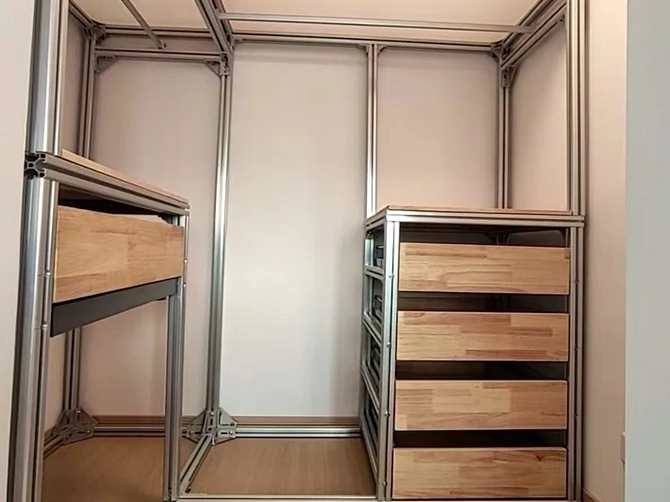
For Furniture and Cabinetry: Aluminum provides superior dimensional stability, moisture resistance, and weight savings. Wood offers timeless beauty and warmth but may warp, swell, or require refinishing in humid environments .
For Outdoor Structures: Aluminum pergolas and deck substructures require essentially no maintenance, resist weathering, and last decades without replacement. Wood offers natural beauty but demands regular sealing and can rot or warp .
For Transportation and Mobile Applications: Aluminum's weight savings, durability, and precision fabrication make it superior to wood for camper vans, trailers, and vehicle structures .
Frequently Asked Questions (FAQ)
Q: Is aluminum or wood stronger?
A: For the same volume, aluminum is significantly stronger than most wood species. Aluminum extrusions have very good mechanical properties with excellent strength-to-weight ratio .
Q: Which lasts longer—aluminum or wood?
A: Aluminum typically lasts longer, particularly in outdoor or humid environments. Wood substructures may only last 10-15 years without careful protection; aluminum structures can last decades with minimal maintenance .
Q: Is aluminum more expensive than wood?
A: Aluminum typically has higher upfront costs than wood. However, over the lifecycle, aluminum's lower maintenance and longer service life often make it more economical. For kitchen cabinets, aluminum costs $180-$350 per linear foot, comparable to high-quality wood at $130-$400 .
Q: Which is more environmentally friendly?
A: It depends on the metric. Wood has lower embodied energy and is renewable. Aluminum is energy-intensive to produce but infinitely recyclable, with high recycling rates that significantly reduce lifecycle impacts .
Q: Can aluminum be used where wood is preferred for aesthetics?
A: Yes. Powder-coated aluminum can mimic wood grain, and when combined with wood accents, it can achieve both durability and natural warmth. Hybrid designs are increasingly common in high-end architecture and furniture.
Related Posts
Aluminum Profile Connection Technologies — Learn about joining methods for aluminum structures.
Aluminum Extrusion in Modular Construction — Explore how extruded aluminum accelerates modern building projects.
Corrosion Protection for Aluminum Extrusions — Understand surface treatments that enhance aluminum's natural durability.
How to Choose an Aluminum Extrusion Supplier — Evaluate suppliers based on technical capability and quality systems.
Applications of Aluminum Extrusion in Different Industries — See how aluminum extrusions serve construction, furniture, and other sectors.
About Aluleader
With over 15 years of experience in the aluminum extrusion industry, Aluleader provides high-quality architectural profiles, industrial profiles, and furniture/decorative profiles. Our integrated capabilities—from die design and extrusion to CNC machining, surface finishing, and fabrication—ensure consistent quality across every project.
Our engineering team collaborates with clients to select the optimal material and profile design for each application, balancing performance, durability, aesthetics, and cost. For project-specific questions or detailed inquiries about aluminum solutions for your application, our experts are available to provide technical guidance.