Welcome to Aluleader Metal
Aluminum Extrusion Carbon Footprint: Cradle-to-Gate & Reduction Strategies | Aluleader
As carbon border tariffs and corporate net-zero commitments reshape the global manufacturing landscape, understanding the carbon footprint of aluminum extrusions has become an operational necessity. For buyers and engineers, this means moving beyond simple price comparisons to evaluating the embodied carbon of the profiles they specify.
This guide breaks down how a product carbon footprint (PCF) for an aluminum extrusion is calculated—from raw material extraction to the factory gate—and outlines practical strategies for reducing emissions across the value chain.
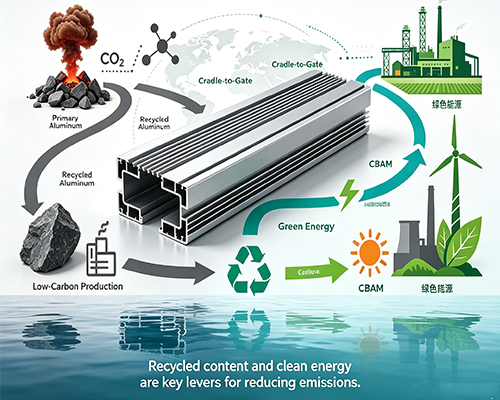
Defining the System Boundary: What Does "Cradle to Gate" Mean?
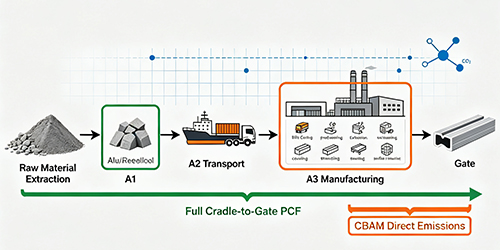
In life cycle assessment (LCA) terms, "cradle to gate" covers all emissions from raw material extraction (the cradle) up to the point the finished product leaves the manufacturing facility (the gate). For aluminum extrusions, this system boundary is defined by the EN 15804+A2 standard and encompasses three core modules :
Module A1 (Raw Material Supply): Bauxite mining, alumina refining, and primary aluminum smelting or scrap collection and sorting for recycled routes
Module A2 (Transport): Transport of raw materials (alumina, scrap, alloying elements) to the processing facility
Module A3 (Manufacturing): All processing steps—billet casting, preheating, extrusion, cooling, stretching, aging, and any secondary operations like sawing or surface treatment
Notably, the CBAM (Carbon Border Adjustment Mechanism) methodology, which applies to imports into the EU, defines a narrower system boundary for compliance purposes. Under the final CBAM rules, only direct emissions from the production site are counted—upstream emissions from raw material extraction are excluded . For an accurate product carbon footprint, however, the full cradle-to-gate scope remains the standard.
The Carbon Intensity of Aluminum: A Material with Wide Variance
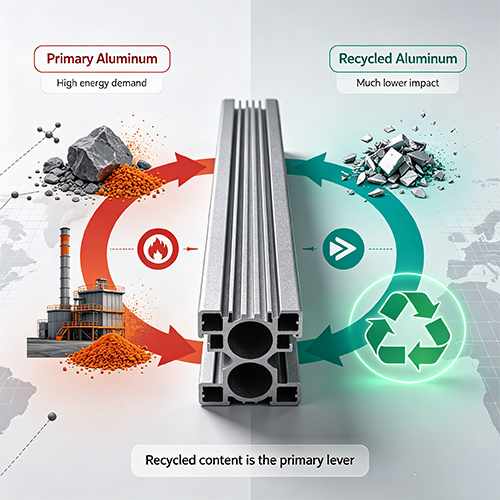
The single most important factor in the carbon footprint of an aluminum extrusion is whether the metal content is primary (from bauxite) or recycled. The difference is staggering.
Primary Aluminum: The Carbon Heavyweight
Primary aluminum production is energy-intensive, with emissions driven by the electrolytic smelting process. The carbon footprint of primary aluminum varies dramatically depending on the electricity source used for smelting.
In Europe, where the smelting mix includes approximately 78% renewable energy, the cradle-to-gate carbon footprint of primary aluminum is approximately 6.3 kg CO₂e per kilogram of aluminum produced . However, the "consumption mix" — which accounts for imports from regions with higher carbon electricity — is significantly higher, at approximately 9.7 to 10.1 kg CO₂e per kilogram .
For perspective, China's national average carbon footprint for aluminum products is approximately 16.38 kg CO₂e per kilogram, reflecting a heavily coal-dependent electricity grid . A global average for extruded aluminum profiles with 31% recycled content is approximately 13.18 kg CO₂e per kilogram .
Recycled Aluminum: A Fraction of the Impact
Recycled aluminum requires only about 5% of the energy needed to produce primary aluminum . The cradle-to-gate carbon footprint of recycled aluminum is approximately 0.26 to 0.37 kg CO₂e per kilogram — roughly 40 times lower than primary metal .
This enormous gap means that the recycled content fraction is the primary lever for reducing the carbon footprint of any aluminum extrusion.
From Billet to Profile: Adding the Extrusion Process Emissions
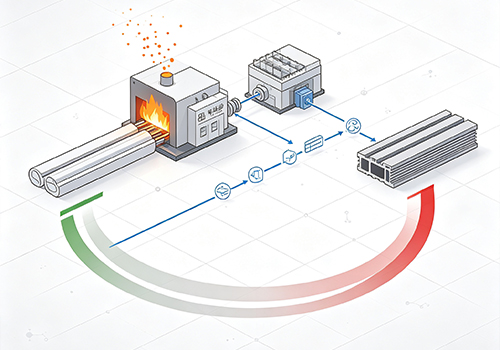
The extrusion process itself adds emissions, primarily from the energy used to preheat the billet and run the press. According to the European Aluminium Environmental Profile Report, the extrusion fabrication process contributes approximately 0.38 kg CO₂e per kilogram of extruded product (gate-to-gate) .
When added to the billet carbon footprint, the total cradle-to-gate figure for an extrusion depends entirely on the metal source:
100% recycled aluminum billet: Approximately 0.26 + 0.38 = 0.64 kg CO₂e/kg
EU primary aluminum (consumption mix): Approximately 10.1 + 0.38 = 10.48 kg CO₂e/kg
Global average (31% recycled): Approximately 13.18 kg CO₂e/kg
The CBAM methodology provides a more detailed breakdown. For a typical extrusion facility, the direct emissions from the forming process itself (module A3) are approximately 0.047 t CO₂e per ton of product, before accounting for the upstream billet emissions . This confirms that the fabrication step, while significant, is a small fraction of the total when primary aluminum is used.
Breaking Down the Emissions: What Contributes to the Total?
A comprehensive carbon footprint calculation for an extrusion facility involves several emission sources.
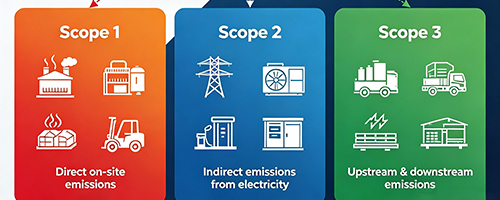
Scope 1: Direct Emissions
Direct emissions from sources owned or controlled by the facility. For an extrusion plant, these typically include:
Natural gas combustion: Used for billet heating, die preheating, and aging furnaces. In one Taiwanese extrusion case study, natural gas combustion accounted for approximately 45% of total facility emissions
Fugitive emissions: Refrigerants and other process gases
On-site transportation: Forklifts and material handling equipment
Scope 2: Indirect Emissions from Purchased Energy
Electricity consumption is typically the largest or second-largest emission source for an extrusion facility. In the same case study, purchased electricity accounted for nearly 50% of total facility emissions . The actual carbon intensity depends entirely on the local grid mix.
Scope 3: Upstream and Downstream Emissions
For a cradle-to-gate product carbon footprint, upstream Scope 3 emissions are already included in the billet carbon factor (module A1). For a full corporate carbon footprint, these are reported separately.
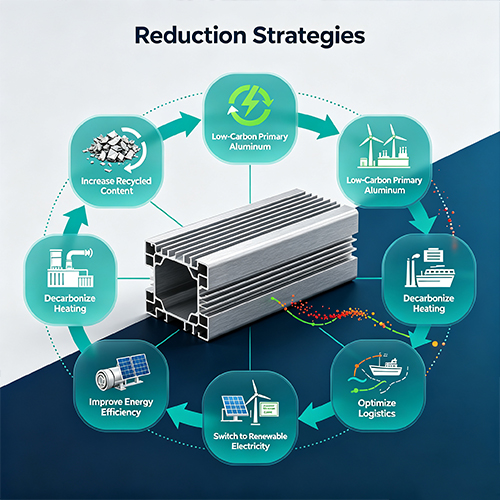
Reduction Strategies: From Billet to Furnace
1. Increase Recycled Content
The most impactful strategy is to source billets with high recycled content. A billet with 75% post-consumer scrap content can reduce the product carbon footprint by up to 75% compared to primary-only material. The development of alloys designed specifically for high recycled content—such as Hydro's S-grade portfolio—demonstrates that performance and sustainability can coexist.
2. Transition to Low-Carbon Primary Aluminum
Where recycled content is not feasible for technical reasons (such as certain aerospace or structural applications), sourcing primary aluminum from smelters powered by renewable energy can dramatically reduce the billet footprint. The difference between the global average (16.38 kg CO₂e/kg) and the European consumption mix (10.1 kg CO₂e/kg) illustrates the impact of the electricity source .
3. Decarbonize the Heating Process
The billet preheating step is the primary source of direct emissions in the extrusion process. Recent technology developments offer a clear pathway to near-zero emissions:
Zero-carbon ammonia fuel: In August 2025, the industry's first zero-carbon ammonia-fueled billet heating furnace was demonstrated in Foshan, China. The technology achieves zero carbon emissions during operation, with no SOx or particulate emissions and NOx levels well below national ultra-low emission standards .
Electrification: Where the local grid is low-carbon, electric billet heating (induction or resistance) can eliminate on-site combustion emissions.
Hydrogen: Green hydrogen is another zero-carbon fuel option, though infrastructure and cost remain barriers.
4. Improve Energy Efficiency
The Taiwanese case study found that equipment age was a primary driver of high energy consumption. Upgrading to energy-efficient motors, optimizing furnace insulation, and implementing waste heat recovery can reduce both Scope 1 and Scope 2 emissions. In the case study, the company projected a 3% improvement in product yield and a reduction of approximately 13.7 t CO₂e/year through equipment upgrades .
5. Switch to Renewable Electricity
For Scope 2 emissions, purchasing renewable electricity through green tariffs or power purchase agreements (PPAs) is a direct and effective strategy. The Japanese company UACJ has launched "green billet" products manufactured using 100% non-fossil energy (hydro, solar, and wind), achieving a 50% reduction in GHG emissions compared to conventional products .
6. Optimize Logistics and Supply Chain
Module A2 (transport) can be minimized by sourcing billets from regional suppliers and optimizing shipping routes. For extrusions exported internationally, this contribution can be significant.
Frequently Asked Questions (FAQ)
Q: What is the carbon footprint of a typical aluminum extrusion?
A: The cradle-to-gate carbon footprint varies dramatically based on recycled content and electricity source. A 100% recycled extrusion may be around 0.64 kg CO₂e/kg, while a primary aluminum extrusion from the global average can exceed 13 kg CO₂e/kg.
Q: How does CBAM affect aluminum extrusion imports?
A: Under the CBAM final rules, the carbon price for imported aluminum goods is calculated based on direct emissions from the production site only. The first compliance period begins in 2026, and importers must report the embedded emissions of their products.
Q: What is the largest contributor to an extrusion's carbon footprint?
A: For extrusions made from primary aluminum, the billet production (module A1) is by far the largest contributor, accounting for approximately 95% or more of the total cradle-to-gate footprint. The extrusion process itself contributes less than 5%.
Q: Can aluminum extrusions achieve net-zero carbon?
A: Yes, through a combination of high recycled content, renewable electricity for smelting and extrusion, and zero-carbon fuel for billet heating. Technologies such as ammonia-fueled furnaces and green billets are already commercially available or in advanced demonstration stages.
Q: What is the carbon footprint of recycled aluminum?
A: Recycled aluminum has a cradle-to-gate carbon footprint of approximately 0.26 to 0.37 kg CO₂e/kg — roughly 40 times lower than primary aluminum.
Q: How do I verify my supplier's carbon footprint claims?
A: Request Environmental Product Declarations (EPDs) or product-specific carbon footprint reports that are third-party verified. These should clearly state the system boundary, methodology, and data sources used.
Related Posts
Aluminum Extrusion Sustainability: Green Billets, PCF & EPD — Explore the sustainability pathway in depth, including closed-loop water systems and EPD standards.
Aluminum Extrusions in EV Battery Enclosures — Understand the role of lightweight aluminum extrusions in reducing vehicle emissions.
Aluminum Extrusion Market Outlook 2026-2027 — Learn about market trends driving the push for lower-carbon materials.
Aluminum Extrusion Process: 11 Key Steps Explained — Understand the manufacturing process and its energy consumption points.
Extruded Aluminum vs Die Cast: Comparison Guide — Compare the carbon intensity of different manufacturing processes.
About Aluleader
With over 15 years of experience in the aluminum extrusion industry, Aluleader provides high-quality architectural profiles, industrial profiles, and furniture/decorative profiles. We are committed to supporting our clients' sustainability goals by offering profiles with optimized recycled content, energy-efficient production processes, and transparent carbon reporting.
For project-specific questions or detailed inquiries about the carbon footprint of our extrusions, our engineering team is available to provide technical guidance and product-specific data.