Welcome to Aluleader Metal
Aluminum Extrusion Surface Finishing: Design Considerations for Anodizing & Powder Coating | Alulead
Surface finishing transforms an extruded aluminum profile from a functional shape into a finished component—one that resists corrosion, meets aesthetic requirements, and performs reliably in its intended environment. However, decisions made about surface treatment during the design phase have far-reaching consequences for dimensional accuracy, production cost, and product performance.
This guide examines how different surface finishing options—anodizing, powder coating, and mechanical finishes—affect aluminum extrusions, with specific focus on the design decisions that determine success or failure.
Why Surface Finish Decisions Must Come Early
The quality and cost-efficiency of an aluminum profile are determined by approximately 70% during the design phase . Surface finishing is no exception. Waiting until after extrusion to consider finish requirements often leads to costly rework, rejected parts, or performance failures that could have been prevented with simple design adjustments.
Key principle: A finish cannot hide what the extrusion process creates. Die lines, flow marks, scratches, and machining marks that are acceptable in a mill finish may become glaring defects after anodizing. If a surface must appear uniform after finishing, it must already be uniform beforehand .
Anodizing: The Integrated Finish
Anodizing is an electrochemical process that converts the aluminum surface into a controlled oxide layer. Unlike a coating, the anodized layer grows from the aluminum itself—it cannot peel or chip .
How Anodizing Affects Dimensions
The anodizing layer grows both into the aluminum (approximately 50%) and outward from the original surface (approximately 50%). For standard anodizing (Type II), total thickness typically ranges from 5 to 25 microns, meaning dimensional buildup is only 2.5 to 12.5 microns per surface . For precision features with tight tolerances (such as ±0.02–0.05 mm or tighter), anodizing's thin, partially inward-growing layer has minimal impact . This makes anodizing the preferred choice for precision components where fit is critical.
Design implication: For threaded holes, bearing surfaces, or press-fit diameters, the anodizing buildup is typically small enough to ignore for standard tolerances. However, for ultra-tight fits, masking or specifying pre-finish dimensions may still be necessary. Hard anodizing (Type III) produces a thicker layer (25–100 microns) with greater dimensional impact and should be accounted for during design .
Alloy Selection and Anodizing Appearance
Not all aluminum alloys anodize equally. Alloys optimised for surface quality, such as 6060 and 6063, typically produce more uniform colour and a cleaner, more consistent appearance. Higher-strength alloys, such as 6061 and 6082, often show colour variation, streaking, or patchiness, and are more sensitive to process variations .
Critical design consideration: Pursuing aesthetic anodized finishes on structural alloys frequently leads to additional processing, rework, or rejection—without improving functional performance. If appearance is critical, alloy selection must prioritise anodizing behaviour early, even if this requires accepting lower mechanical strength and compensating through geometry . For die-cast aluminium alloys with high silicon content (such as A380 or A356), anodizing should be crossed off entirely—the high silicon content causes uneven, unattractive films .
Design Details That Affect Anodizing Quality
Corner radii: Sharp internal corners create stress concentration in the die steel and also cause finishing problems. An anodizing layer cannot form effectively on sharp edges (the "knife-edge effect"), leading to cracking. Designers should apply a minimum radius of 0.5–1.0 mm to all internal and external corners to ensure a superior surface finish .
Surface uniformity: Webs, flanges, and abrupt changes in metal thickness may show up as marks on the opposite surface of an extrusion, particularly on thin sections. Thoughtful design—including streamlining transitions and avoiding sudden thickness changes—minimises these show-through defects . Anodising will not cover these defects.
Specify critical surfaces: If a product has surfaces that are exposed in use, where normal processing marks may be objectionable, the extruder should be told which surfaces are critical. The narrower the exposed surface, the more uniform will be its finish .
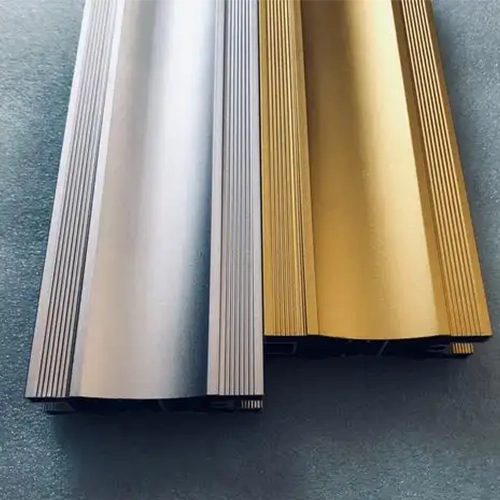
Powder Coating: The Versatile Barrier
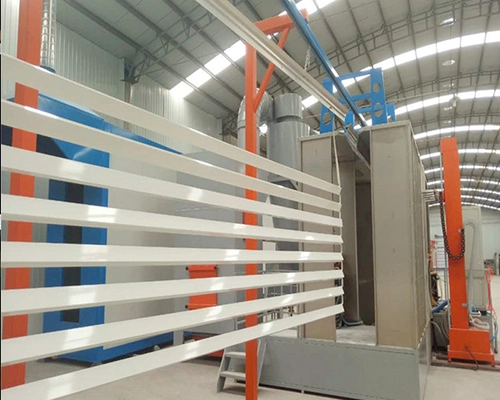
Powder coating applies an electrostatically charged dry powder (typically polyester, epoxy, or hybrids) that is cured in an oven at 160–200°C, forming a thick, continuous polymer skin .
The Dimensional Challenge
Powder coating is where many designs go wrong. Coating thickness typically ranges from 60 to 150 microns (0.002–0.006 inches) . For a precision bore with a ±0.05 mm tolerance, a 100 µm powder coat on all surfaces would reduce the bore diameter by 0.2 mm—creating interference with all mating features. The part fails assembly inspection and must be stripped, re-machined, and recoated, at significant cost and schedule delay .
Design best practices:
Identify every precision feature on the drawing and calculate the coating thickness impact on each
Mask critical features such as bores, threads, and mating surfaces that cannot tolerate added thickness
Design with compensation by specifying pre-coat dimensions that account for the final coating thickness
For parts requiring precision fits and powder coating, consider applying the coating before final machining, then machine critical features after coating to achieve the final dimensions
Where Powder Coating Excels
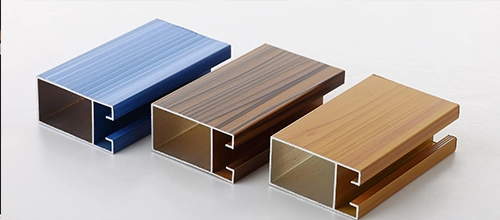
Powder coating offers distinct advantages for specific applications. It provides unlimited colour options (virtually any RAL colour), excellent batch-to-batch consistency, and can be applied in textures (wrinkle, matte, gloss, metallic) that anodizing cannot achieve . It hides minor surface porosity or machining marks better than anodizing, making it suitable for parts with surface imperfections .
For large external housings, outdoor machinery frames, and decorative casings with loose tolerances (±0.005 inches or greater), powder coating provides excellent UV and weather resistance with lower initial cost than hard anodizing .
Critical limitation: Powder coating reduces heat dissipation, making it unsuitable for thermal management components such as heat sinks .
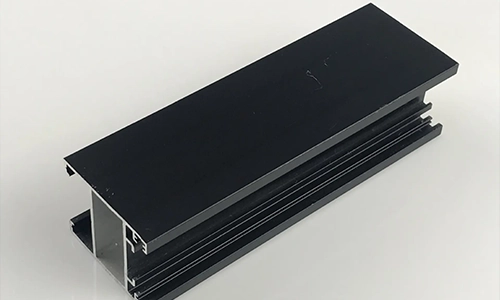
Choosing Between Anodizing and Powder Coating: The Decision Framework
The choice depends on the specific functional and aesthetic requirements of your application.
Choose Anodizing When
Precision dimensions are critical. The thin, partly inward-growing oxide layer of anodizing (2.5–12.5 microns per surface) has minimal impact on precision features .
Wear resistance is required. Anodized surfaces have excellent abrasion resistance, making them ideal for sliding surfaces, frequently handled parts, and components subject to mechanical contact .
A metallic aesthetic is important. Anodizing provides a natural metallic appearance that powder coating cannot replicate. Premium instruments, consumer electronics, and architectural components often specify anodizing for this reason .
Electrical insulation is required. Anodizing provides reliable electrical isolation properties that powder coating does not provide .
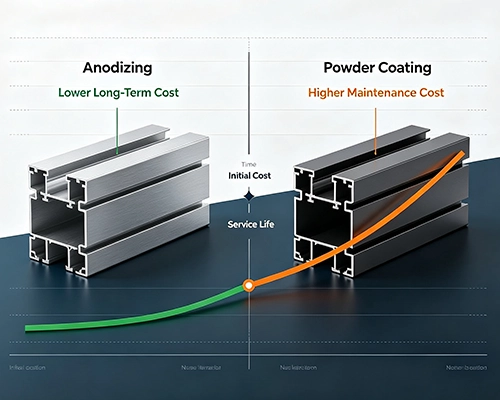
Long service life with limited maintenance access. Anodizing's integrated layer never needs recoating, making it the lower total-cost-of-ownership choice for industrial components in wear environments .
Choose Powder Coating When
Color customisation is the priority. Powder coating offers unlimited colours, textures, and gloss levels with excellent batch-to-batch consistency—superior to anodizing dye processes .
Surface imperfections need to be concealed. The thicker coating layer hides defects that anodizing would reveal .
Parts are large or have complex shapes. Powder coating is not limited by bath dimensions as anodizing can be .
High-volume production at lower initial cost is the key constraint. Powder coating's simpler process and faster throughput make it more cost-effective per part in high volumes for non-precision applications .
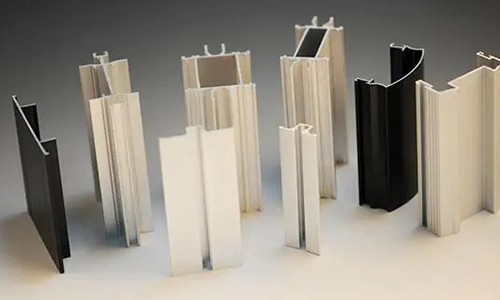
Mechanical Finishes: Texture and Preparation
Mechanical finishes—grinding, polishing, brushing, sandblasting, and buffing—serve multiple purposes . They can refine surface quality, create specific textures, or prepare aluminum for subsequent finishes .
Design Considerations for Mechanical Finishes
Plating considerations: While aluminium can be plated to achieve mirror finishes, the extrusion surface must be prepared with specific characteristics. For bright plating, the aluminium surface must be flat or slightly convex before polishing; concave surfaces do not polish evenly . This must be designed into the extrusion, as standard extrusions often have slightly concave surfaces to protect against damage during handling.
Surface specification: If machined areas will be visible, the drawing must specify surface finish requirements, direction of brushing, class of anodizing, colour tolerances, masking requirements, and acceptable cosmetic limits.
Lifecycle Cost Considerations
The total cost comparison between finishes often reverses when maintenance, replacement, and failure costs are included. Powder coating may be less expensive initially, but for an industrial component subject to wear, the cost of premature coating failure—recoating, downtime, or component replacement—frequently exceeds the initial cost differential between processes. Anodizing's durability advantage translates to a lower total cost of ownership across a product's service life in these applications .
Decision rule: For architectural panels and non-abrasive service environments, powder coating's barrier protection is adequate, and the lower initial cost is the correct decision. For wear-prone industrial components, anodizing's lifecycle economics are superior .
Frequently Asked Questions (FAQ)
Q: Does anodizing change the dimensions of my part?
A: Yes, but minimally. Anodizing grows inward and outward—approximately 50% of the total thickness extends outward. For standard anodizing (5–25 microns total), dimensional buildup is 2.5–12.5 microns per surface. For most applications, this is negligible. Hard anodizing (25–100 microns) has greater impact and requires compensation .
Q: Which finish should I choose for a heat sink?
A: Anodizing is the preferred choice. Powder coating acts as a thermal insulator and reduces heat dissipation—unsuitable for thermal management components .
Q: Can I powder coat a precision-machined part with tight tolerances?
A: Only with careful planning. Powder coating adds 60–150 microns per surface, which can close bores and ruin press-fit diameters. Identify critical features, mask them, or design for pre-coat dimensions and post-coat machining .
Q: Why does my anodized part show defects that weren't visible before?
A: Anodizing does not hide defects—it often accentuates them. Die lines, flow marks, scratches, and machining marks remain visible and are often highlighted by the anodizing process. Design decisions must ensure surface uniformity before finishing .
Q: What radius should I specify for corners?
A: Apply a minimum radius of 0.5–1.0 mm to all internal and external corners. Sharp corners create stress concentration in dies and cause "knife-edge" and "edge-pull" effects during anodizing and powder coating, leading to cracking or insufficient coverage .
Related Posts
CNC Machining Aluminum Extrusions: Ultimate Guide — Understand machining tolerances and how they interact with surface finishing.
How to Read Aluminum Extrusion Drawings — Learn how to specify finish requirements and critical surfaces on drawings.
Corrosion Protection for Aluminum Extrusions — Explore corrosion protection strategies in depth.
Aluminum Extrusion Tolerance Design Guide — Understand tolerance design principles that affect finishing decisions.
Extruded Aluminum vs Die Cast: Comparison Guide — Understand how manufacturing process affects alloy choice and finishing options.
About Aluleader
With over 15 years of experience in the aluminum extrusion industry, Aluleader provides high-quality architectural profiles, industrial profiles, and furniture/decorative profiles. Our integrated capabilities—from die design and extrusion to CNC machining, surface finishing, and fabrication—ensure consistent quality across every project.
Our engineering team collaborates with clients to select the optimal alloy, profile design, and surface finish for each application, balancing performance, aesthetics, durability, and cost.
For project-specific questions or detailed inquiries about surface finishing options for your application, our experts are available to provide technical guidance.